


How retained recruitment changed Louise Archer’s business
Feeling overwhelmed by the unpredictable nature of contingent recruitment?Retained recruitment involves clients paying upfront for hiring services, ensuring financial stability for recruiters. This model allows recruiters to focus on quality without the unpredictability of contingent recruitment.
You’re not alone. Louise Archer, founder of Retrained Search(opens in a new tab), has been there too.
In an eye-opening interview with Recruit CRM(opens in a new tab), she shares her journey from contingent to retained recruitment, discusses the challenges she faced, and offers invaluable tips on creating a supportive work environment and navigating ethical dilemmas.
Louise’s insights are packed with practical advice that can change your approach to recruitment.
Watch the full conversation here or dive into the blog to learn more.
How did Louise discover the retained model?
Louise’s (opens in a new tab)frustration with the contingent model reached a breaking point. Long hours, unpredictable clients, and inconsistent results made her question her career.The game-changer? Her introduction to the retained recruitment model. Suddenly, Louise realized that this approach wasn’t just for top-level executives in fancy suits—it was something she could achieve, too.
Transitioning to retained recruitment changed everything for her. Securing financial commitments from clients allowed her to implement a reliable process and achieve better results.
This shift wasn’t just about earning more—it was about gaining control and stability in her work.
These transformations highlight how retained recruiting can lead to significant business growth and stability.
So, what is retained recruitment, and why should you consider it?
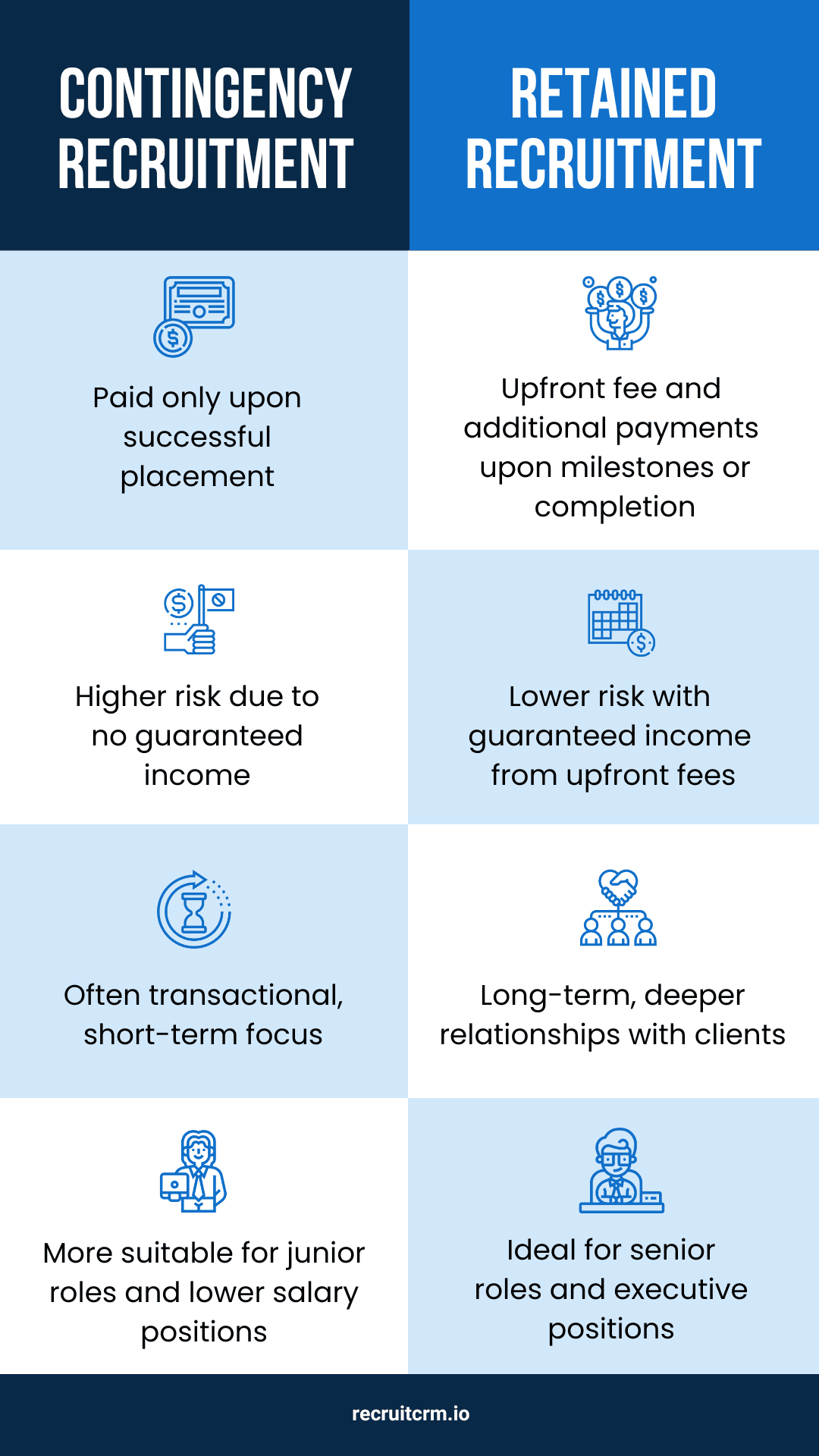
Retained search is a recruitment model in which companies approach a search agency to help them fill a vacancy.
This model works on a contractual basis, and the recruiter receives a portion of the fee decided upfront.
On the other hand, in a contingency search, the recruiter gets paid if and only if the candidate they find is successfully hired by the company and shows up for the job. The phrase " no win, no fee” best describes this model.
Contingency search is not as secure as retained for several reasons. Without a guaranteed source of income, a contingency recruitment model is riskier and not advisable to base your agency off on.
However, if your recruitment agency is focused on hiring for more junior roles or attracting candidates from the bottom of the salary spectrum, then contingency recruiting might be a very good option. In fact, here retained search might be overkill.
Wait! That’s not the only thing Louise has talked about. Get more scoop here:
Frequently asked questions
1. How do I pitch retained recruitment to new clients?
To successfully pitch retained recruitment, emphasize the stability and quality it provides compared to contingent recruitment.Explain how the upfront payment ensures a commitment from both sides, allowing recruiters to dedicate more time to finding the best candidates.
Highlight the advantages of a structured process and transparent communication. Provide case studies or success stories to reinforce your points and demonstrate how this model benefits both the recruiter and the client.
2. What are the risks of switching from contingent to retained recruitment?
Switching from contingent to retained recruitment can involve risks, mainly if your clients are accustomed to the "no-win, no-fee" model.The main challenge is overcoming clients' reluctance to pay upfront. It may take time to educate clients on the benefits of guaranteed commitment, and some clients may initially hesitate to adopt this model.
However, once the process is streamlined and clients see the value in focused, high-quality recruitment, the transition can lead to more stable, long-term partnerships.
3. Can small recruitment agencies adopt retained recruitment?
Yes, small recruitment agencies can absolutely adopt retained recruitment.While larger agencies may be more accustomed to this model, smaller agencies can leverage retained recruitment for niche markets or senior-level roles where quality and commitment matter more than volume.
It may require an initial investment in educating clients and setting expectations, but the long-term benefits of stability and higher-quality placements can be substantial.
Blog summary
Louise Archer, founder of Retrained Search, shares her transformative journey from contingent recruitment to retained recruitment.She reveals the challenges she faced in the contingent model and how switching to retained recruitment brought stability and control.
Unlike contingent recruitment, where payment depends on a successful hire, retained recruitment ensures a financial commitment upfront, offering a more predictable income stream.
Here are some key insights from Louise’s experience:
- Retained recruitment offers stability: Unlike contingent models, which are dependent on successful hires, the retained model guarantees financial commitment upfront.
- Business growth: The retained model allowed Louise to implement more reliable processes, leading to consistent results and growth.
- Control over work: With retained recruitment, Louise could focus on quality and process rather than chasing uncommitted clients.
- Less unpredictability: The retained approach eliminated the uncertainty of contingent recruitment, which often yields inconsistent results.


Get 20% commission on cash collected per month from every customer you refer for upto one year.
Join Recruit CRM’s affiliate program and start making money.
Categories
Stay ahead with the smartest
recruitment newsletter out there!
Join 30K+ recruiters reading the best newsletter in recruitment.