


What is revenge quitting & how can recruiters tackle it?


Revenge quitting is when an employee resigns at a disruptive moment to send a message, often due to unmet expectations, lack of recognition, perceived unfairness, no career growth, or accumulated frustrations.
A few months later, the same role lands back on your desk because the employee just resigned.
But now the position is urgent, the hiring manager wants a replacement immediately, and you are being pressured from every direction.
When exits like this occur at particularly painful moments, it's called revenge quitting.
Keep reading to find out exactly what this trend is and how you can prevent it.
What is revenge quitting?
Revenge quitting is a situation in which an employee resigns at a moment that deliberately creates disruption and chaos in the workplace.The intention is not simply to leave the job. The timing of the exit is meant to send a message to the organization.
To better understand it, take a look at how revenge quitting differs from other workplace trends you may have heard about.
| Behavior | What it means | Key difference |
| Voluntary turnover | Employees leave for another opportunity or career move | A typical resignation |
| Quiet quitting | Employees stay in the role but limit their effort to basic responsibilities | They remain employed |
| Revenge quitting | Employees resign at a moment that causes operational disruption | The timing is intentional |
At some point, one incident pushes the employee to leave. Instead of resigning at a routine time, they choose a moment when their absence will be felt the most.
Top 5 reasons behind revenge quitting
1. Mismatch between promises and reality
One of the biggest triggers behind revenge quitting is the gap between what candidates are promised during recruitment and what the job actually looks like after they join.When recruiters do not probe the client deeply enough about what the role looks like day to day, or when they oversell an opportunity to close a placement faster, candidates join with expectations that the employer was never going to meet.
During the hiring process, candidates may hear about growth opportunities, flexible work arrangements, strong leadership, or meaningful projects. But after joining, strategic work turns into routine tasks, decision-making is limited, or flexibility quietly disappears.
Most employees give the role time and raise concerns with their manager or during performance reviews. When those concerns are repeatedly dismissed, disappointment gradually turns into frustration.
2. Lack of recognition and feedback
Employees want to know their work matters.When someone consistently delivers results but rarely receives feedback or recognition, motivation begins to drop. Over time, employees may feel their contributions are invisible.
Instead of repeatedly raising the issue, many simply withdraw. They stop sharing ideas, stop volunteering for extra work, and slowly disengage from the team.
This is a warning sign that often goes unnoticed by agency recruiters because most agencies lack a structured process to check in on placed candidates after the start date.
Without regular feedback and acknowledgment, even high-performing employees may begin looking for an exit.
3. Perceived unfair treatment
Fairness strongly affects employee engagement and retention.Employees notice when workloads are uneven, when certain colleagues receive better opportunities, or when workplace policies apply differently across teams. Even small patterns of favoritism can create resentment if they continue long enough.
You can surface this risk before placement by asking candidates about their past experiences with team dynamics and management styles, and cross-referencing those answers with the client's description of their culture.
When employees start believing the system is unfair, trust in leadership begins to decline.
4. No clear path for career growth
Career development is a major reason employees stay with a company.Many join expecting their role to evolve, with opportunities to build new skills or take on greater responsibility. Problems arise when those conversations never translate into real opportunities.
Promotions are delayed, internal roles never open up, and career discussions repeat without progress. Eventually, employees begin to believe the only way to grow is to leave.
To avoid this, you need to ask clients directly what progression looks like for the role and communicate that honestly to candidates, not just at the offer stage but throughout the process. If the client can’t answer it clearly, it is a risk worth mentioning to the candidate.
5. Frustrations that build over time
In revenge quitting instances, there is no single dramatic incident behind the resignation.Instead, small frustrations accumulate. Missed promotions, unclear communication, workload pressure, or repeated misunderstandings with leadership.
Each issue may seem manageable on its own, but together they create a growing sense that nothing will improve. By the time the employee resigns, the decision often feels sudden to the organization but long overdue to the employee.
Because agencies typically hand off after a placement is made, this slow buildup becomes invisible to them. By the time the candidate resigns, the decision often feels sudden to the client but long overdue to the candidate.
Regular check-ins at the 30-, 60-, and 90-day marks with both the placed candidate and the hiring manager would catch many of these frustrations before they reach a breaking point.
What can recruiters do to prevent revenge quitting?
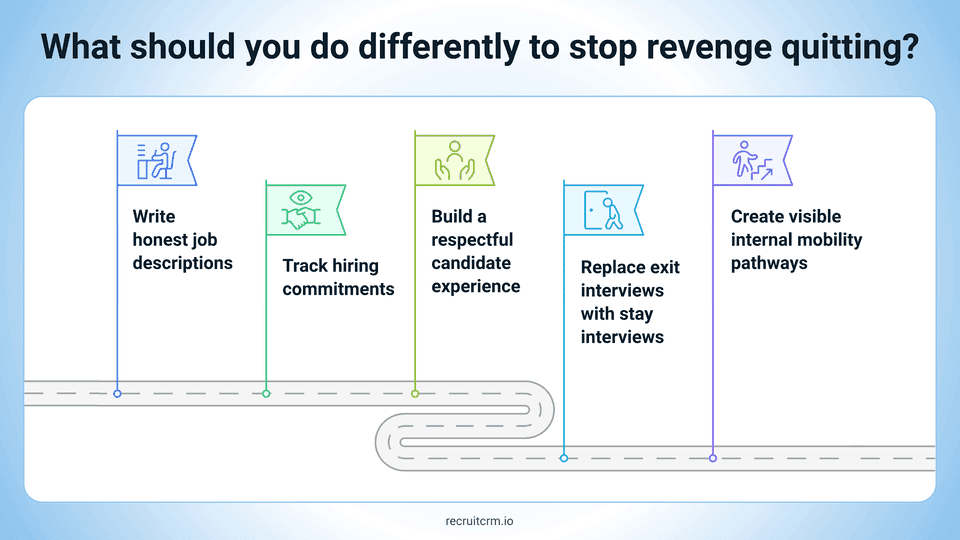
1. Qualify the client brief rigorously
Job descriptions are the first place candidates form their expectations, and they need to reflect the reality of the role. Too often, agencies write descriptions based on a surface-level brief without pushing the client on what the role actually involves day to day.If the role promised growth, autonomy, and exciting projects but turns out to be more operational or repetitive, the employee may quickly feel misled and quit in revenge.
To avoid this, be upfront about the role's responsibilities and the challenges employees will face. Describe the team dynamics, leadership style, and growth timelines clearly. Include both the good and the challenging parts of the job.
Regularly audit your recruitment messaging, including job ads, career pages, and employer value proposition, to compare what’s promised during hiring to the actual employee experience. If you find gaps between the two, address them immediately.
2. Track hiring commitments
Promises made during interviews can be overlooked once the employee joins, leading to dissatisfaction and disengagement. Employees may have been told about growth opportunities or special projects, but when those promises aren't fulfilled, trust is lost.For this reason, you should document the key promises made during the hiring process regarding mentorship, career development, or team structure. Share this information with the hiring manager during onboarding to ensure alignment on both sides.
This also protects the agency. When a placement exists early, and the client pushes back, having a record of what was communicated and to whom gives you a clearer picture of where the breakdown happened.
3. Build a respectful candidate experience
From the moment candidates apply, they are forming an opinion about the agency and, by extension, the client. How they are treated during recruitment directly shapes how they feel about the role before they even start.A slow process, unclear timelines, or lack of communication can create a negative candidate experience, even if the role itself is a good fit.
Ensure timely communication with candidates throughout the process. Set clear expectations about timelines, respond quickly to questions, and provide feedback after interviews.
The way you run the hiring process sends a signal about the kind of employer the client is. Make sure that the signal is accurate.
4. Replace exit interviews with stay interviews
Exit interviews are helpful, but by the time you conduct them, the employee has already decided to leave. Stay interviews, on the other hand, help you identify concerns before the resignation is even on the table.Schedule regular stay interviews to check in with employees about their job satisfaction. Ask questions like:
- "What’s frustrating you about your role?"
- "Do you feel you’re getting the growth opportunities you were promised?"
- "What part of your job is the most frustrating right now?"
- "Are there any changes you’d like to see in the team or role?"
5. Flag and manage high-risk placements
Not every role carries the same attrition risk, and agencies that treat all placements the same will eventually absorb the cost of that approach through their guarantee clause.Some clients have a consistent pattern of early exits. Some roles are structurally set up in ways that lead to frustration, such as vague briefs, high workload expectations, or limited manager availability. These are not always dealbreakers, but they are flags worth tracking.
Keep a record of which clients and role types generate the most replacement requests. Use that data to qualify new briefs from those clients more rigorously, set more realistic expectations with candidates for those roles, or adjust your terms accordingly.
Knowing where the risk is concentrated is the first step to managing it.
Frequently asked questions about revenge quitting
1. Does revenge quitting impact employer branding?
Yes, and for recruitment agencies, the brand damage runs in two directions.When a placed candidate resigns in a disruptive way, it signals to the client that the agency may not have properly vetted the candidate or understood the role well enough. If it happens more than once with the same client, it puts the entire account at risk.
It also affects how candidates perceive the agency. Negative experiences shared through word of mouth or social media can make it harder to attract quality candidates for future roles, particularly in sectors where professional networks are tight and reputations travel fast.
2. Are certain industries or roles more prone to revenge quitting?
Yes, certain industries and roles are more prone to revenge quitting. According to a survey by Forbes(opens in a new tab), hybrid employees, managers, and those in marketing and advertising, IT and tech, and media and entertainment are at a higher risk of quitting.These roles often involve high expectations, burnout, and pressure, which can lead to frustration. Employees in these positions may feel disconnected or undervalued, leading them to exit at a disruptive moment to make a statement.
3. How should an agency respond when a placement revenge quits?
The first step is to understand what happened before responding to the client. Speak to the candidate directly to find out what drove the decision and when the frustration started.This will tell you whether the breakdown stemmed from the briefing process, the onboarding experience, or something that emerged after the placement was complete.
Use that information when speaking to the client. A structured post-placement check-in process gives you data to draw on and shows the client that the agency has a process for managing placements beyond the start date.
If the agency needs to activate a replacement clause, treat it as an opportunity to requalify the brief entirely rather than simply re-running the same search. Replacing a revenge quit with another mismatched hire only repeats the problem.
4. What are some warning signs that indicate upcoming revenge quitting?
There are several warning signs recruiters and HR leaders should watch for when an employee is at risk of revenge quitting.These include declining performance, sudden disengagement, increased absenteeism, or a reluctance to take on new tasks. Employees may start to withdraw from team activities or stop participating in long-term planning discussions.
If employees become more silent during feedback sessions or show signs of emotional distance, it’s often an indication that they have already mentally checked out. These signs should not be ignored, as they often precede a disruptive resignation.
Blog summary
- Employees resign at disruptive moments to send a message, often due to unresolved issues such as mismatches between promises and reality, a lack of recognition, or perceived unfair treatment.
- Frustrations build over time from a lack of clear career growth opportunities or accumulated issues, leading to revenge quitting.
- Prevent revenge quitting by ensuring honest job descriptions, tracking hiring commitments, and maintaining a respectful candidate experience.
- Conduct regular stay interviews to address concerns early and create clear internal mobility pathways to support career growth.
- Revenge quitting can damage an employer’s brand by exposing unresolved workplace issues.
- Hybrid employees, managers, and roles in marketing, IT, and media are more prone to revenge quitting.
- Recovery can take a few months with prompt action, but ignoring the issues can prolong the damage.
- Warning signs include declining performance, disengagement, absenteeism, and reluctance to take on new tasks.




Blog written by
Kanan Parmar
Content Manager at Recruit CRM
Kanan Parmar is a content manager at Recruit CRM, specializing in delivering research-driven content that empowers recruiters. Her work focuses on providing valuable insights and strategies that help recruitment professionals optimize their workflows, make informed decisions, and stay ahead in the recruitment industry.
Stay ahead with the smartest
recruitment newsletter out there!
Join the recruiters who never miss what’s next.




![How to master effective candidate communication? [Free outreach templates inside]](/static-assets/_next/image/?url=https%3A%2F%2Frecruitcrm.io%2Fwp-content%2Fuploads%2F2023%2F05%2FThumbnail-httpsrecruitcrm.ioblogscandidate-communication-1.png&w=828&q=75)











 marketing@recruitcrm.io
%201.4700f78c.svg&w=32&q=75) Workforce Cloud Tech, Inc. 28 Mohawk Avenue, Norwood, NJ 07648.
Workforce Cloud Tech, Inc. 28 Mohawk Avenue, Norwood, NJ 07648.


