

9 practical interviewing tips that recruiters can use right away
The difference between a good hire and a great hire comes from how well you conduct your candidate interviews.
With the proper techniques, every candidate interview helps you make an accurate recruitment decision, not create confusion.
The trick to conducting good recruitment interviews lies in increasing the efficiency of your job descriptions, interview questions, behavioral techniques, active listening, and follow-ups.
Curious about how such interviewing tips work? Keep reading!
How can recruiters interview candidates efficiently?
1. Define the role clearly
To make your interviews efficient, it's essential to attract the right candidates.The easiest way to attract high-quality candidates is to craft a well-structured job description that clearly defines the role they are applying for.
When creating a job description, focus on key responsibilities, required skills, and qualifications. Try to make it more specific by mentioning the candidate's job goals and the team structure in which they would be working.
Outlining your company’s core values and culture in the job description reduces the number of mismatched or underqualified applications. The more specific you are, the more likely you’ll be able to focus on relevant candidates during the interview process.
2. Prepare your interview questions in advance
Before you start the interview process, prepare a set of relevant interview questions to assess your candidates' problem-solving skills and cultural fit. You can form these questions based on their resume details.Stick to a semi-structured interview format as it can help you stay on track while leaving some space for follow-up questions.
Apart from resume information, it's essential to conduct thorough background checks to verify candidates' qualifications, work history, and references.
Based on these background checks, you can prepare questions like, “Can you elaborate on the project listed in your resume where you led a team?” or “Have you ever faced challenges in a previous job that required a background check or clearance?”
This makes your candidate interviews more professional, competitive, and efficient.
3. Assess cultural fit ahead of time
As an interviewer, it's important to review your company’s values, mission, and work culture to understand the qualities you’re looking for in a candidate.This helps you probe deeper into how candidates handle teamwork, communication, and conflict by asking questions such as “How do you handle disagreements with colleagues?” or “Describe a time when you had to adapt to a company’s values or culture.”
Instead of hiring candidates who might struggle to adapt to your work culture, by assessing cultural fit in advance, you can hire candidates who will thrive in your organization with higher job satisfaction and a better retention rate.
Assessing cultural fit in advance not only helps you hire suitable candidates for your organization but also ensures higher satisfaction and better candidate retention.
4. Keep your interview panel short
Almost 37% of candidates(opens in a new tab) feel intimidated by an interview with a panel of more than 2 people. Such candidates often feel overwhelmed and confused, leading to a poor candidate experience.To avoid this, try to keep your interview panel smart and short. It creates a comfortable atmosphere that keeps you and your candidates focused and helps you build a strong employer brand.
Limiting the panel size also makes feedback more manageable. It's easier to reach a consensus with fewer opinions to consider. This will help you speed up your hiring process by reducing avoidable delays.
5. Use behavioral interviewing techniques
Understanding candidates' behavior is one of the most effective ways to evaluate their past performance and predict how they may behave in similar situations.Ask questions that focus on real-life examples to get an understanding of candidates' soft skills, such as problem-solving and decision-making, to get an insight into their work patterns and adaptability.
This might include questions like, "Tell me about a time when you had to solve a complex problem at work," or "Can you describe a situation where you had to work with a difficult colleague?"
6. Practice active listening
You can make your recruitment interviews more productive and efficient by focusing on how candidates respond and what they say.By focusing on how candidates express themselves in an interview, you can assess their emotional intelligence and communication skills. This involves being attentive to their tone and any non-verbal cues, such as body language, the depth of their response, and how long they take to respond.
Avoid rushing your interviews and give your candidates enough time to answer the questions. Such active listening skills show respect and help candidates feel comfortable, allowing them to express themselves more openly.
Active listening also helps you make informed decisions by allowing you to gather all the information from the interview, whether verbal or behavioral.
7. Ask about salary expectations
If your job description doesn't mention salary, it's better to address pay expectations to avoid any further misalignments.The best time to talk about salary expectations is early in the interview. If your candidates' expectations exceed your recruitment budget, you can save time by terminating the hiring process for that candidate.
Such salary discussions can also help you understand the candidate’s knowledge about the role and market rates.
Salary discussions are also a strong indicator of transparency and respect for both your time and the candidate’s time. While this sharpens your hiring process, it also enhances your organization's brand.
8. Follow up after the interview
To make your interview process more professional and keep candidates engaged, it's important to follow up after the interview.Appreciate your candidate's time and interest by sending a thank-you note within 24-48 hours after the interview, irrespective of the interview outcome.
If a candidate is selected, make sure to inform them of the next steps, such as the next interview round or the extension of a job offer. If they aren’t selected, notify them of your decision and provide interview feedback to maintain a positive candidate experience.
9. Focus on selling the job
Interviews are not only about assessing candidates' skills, but also about how effectively you sell them on the role.During the interviews, ensure you pitch your organization's unique elements, such as its culture, values, and growth opportunities. Make the job role more attractive by putting equal emphasis on its benefits and requirements.
A single pitch might not work for every candidate. You need to make it personalized based on your candidate's career goals.
For example, if they are seeking career growth, discuss how your job offer can help them achieve it. This way, the candidates feel that their personal goals are validated and are essential to your organization.
Interviewing tips FAQs
1. How can recruiters prepare for a candidate interview?
You should start your preparation for candidate interviews by thoroughly reviewing the candidate’s resume, work experience, and applications to tailor interview questions that are personalized and relevant. Simultaneously, you need to plan the logistics of the interview, which typically includes the interview format (in-person or virtual), time, and platform.Before you begin with the interview rounds, make sure to revise your company’s values, as it will help you assess the cultural alignment of the candidates.
2. What are some common mistakes that recruiters must avoid during candidate interviews?
The following are the most common errors recruiters make during candidate interviews:- Allowing their personal preference or unconscious bias to influence their hiring decisions.
- Asking vague or irrelevant questions that do not provide any meaningful insight.
- Not assessing the cultural fit of a candidate before making the hiring decision.
- Rushing the interview process leads to a mismatch between your organization’s and the candidate's expectations.
3. How can recruiters assess candidates' cultural fit during an interview?
Recruiters can assess a candidate's cultural fit by asking targeted interview questions that explore a candidate's values, work style, and interpersonal skills. For example, this can include questions like, “How do you handle collaboration in a team setting?” or “Describe a time when you had to adapt to a workplace culture that was different from what you were used to.”Such questions help you compare the candidates' values and working patterns with your company's work culture. Additionally, you can observe the candidate’s communication style during the interview to gain insight into their adaptability.
4. How to make recruitment interviews fair and unbiased?
Recruiters can make recruitment interviews fair and unbiased by using the following methods:- Using a set of standardized interview questions that focus on candidates' skills and experience.
- Reducing the influence of unconscious bias on the final decision by using various techniques.
- Documenting the interview process to maintain consistency and accountability.
- Maintaining clear communication with the candidates about the interview process.
5. How can recruiters assess technical skills in an interview?
Recruiters can assess technical skills in interviews by asking candidates about their past projects and work experience that demonstrate their expertise with relevant tools and technologies. For roles requiring hands-on skills, practical assessments can be administered during the interview.Reviewing portfolios or past work can also provide a deeper understanding of their technical competencies. This ensures that the candidate has the technical expertise necessary for the job.
Summary
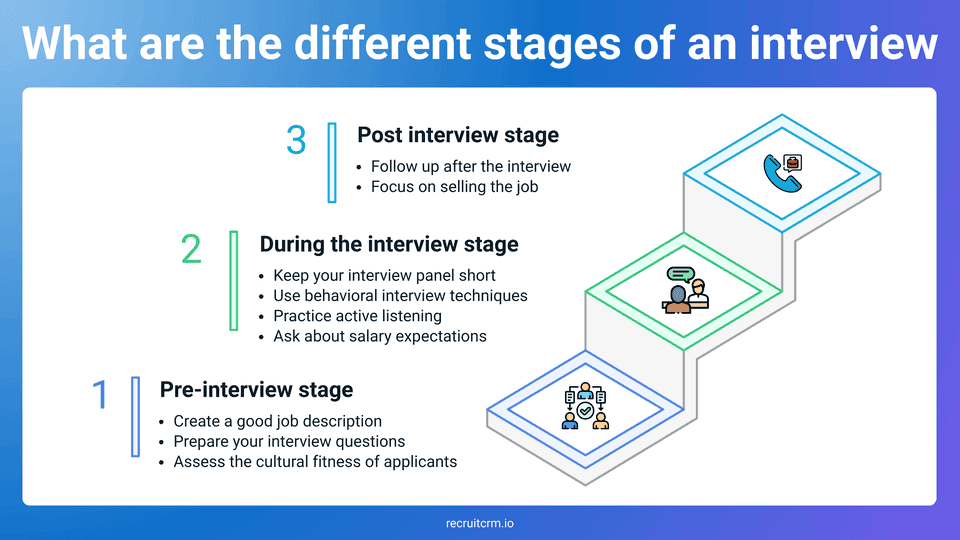
Recruiters can make the various stages of their interview process (pre-interview, interview, and post-interview stages) more effective using the following tips:- Define the job role clearly in the job description.
- Prepare your personalized interview questions in advance.
- Assess the cultural fit of candidates before you begin with the interview.
- Keep your interview panel short to speed up your hiring process.
- Use behavioral interviewing techniques to understand candidates' soft skills and work patterns.
- Practice active listening during the interviews.
- Be transparent about salary expectations with the candidates.
- Conduct timely follow-ups after the interview.
- Focus on selling the job more effectively during the interviews.


Get 20% commission on cash collected per month from every customer you refer for upto one year.
Join Recruit CRM’s affiliate program and start making money.
Categories
Stay ahead with the smartest
recruitment newsletter out there!
Join 30K+ recruiters reading the best newsletter in recruitment.