


How can recruiters use an AI agent?
There’s a well-kept industry secret about AI agents for recruitment that most people won’t tell you: they have far more capabilities than they’re typically advertised for.
Many recruiters spend hours trying to figure out how to use their AI agents effectively, but the real key is having the right strategy and a bit of creativity.
If you are ready to unlock the full potential of your AI agents, this blog has everything you need to get started.
What are AI agents for recruitment?
AI agents in recruitment are frameworks that automate your tasks without requiring recurrent human assistance.Instead of relying on repetitive prompts, these agents can adapt to your company's environment and make informed decisions based on past experience.
That does not mean a single AI agent software would be sufficient for all your hiring needs.
Just like you have different employees for different departments of your company, AI agents in recruitment are widely classified based on their functionality.
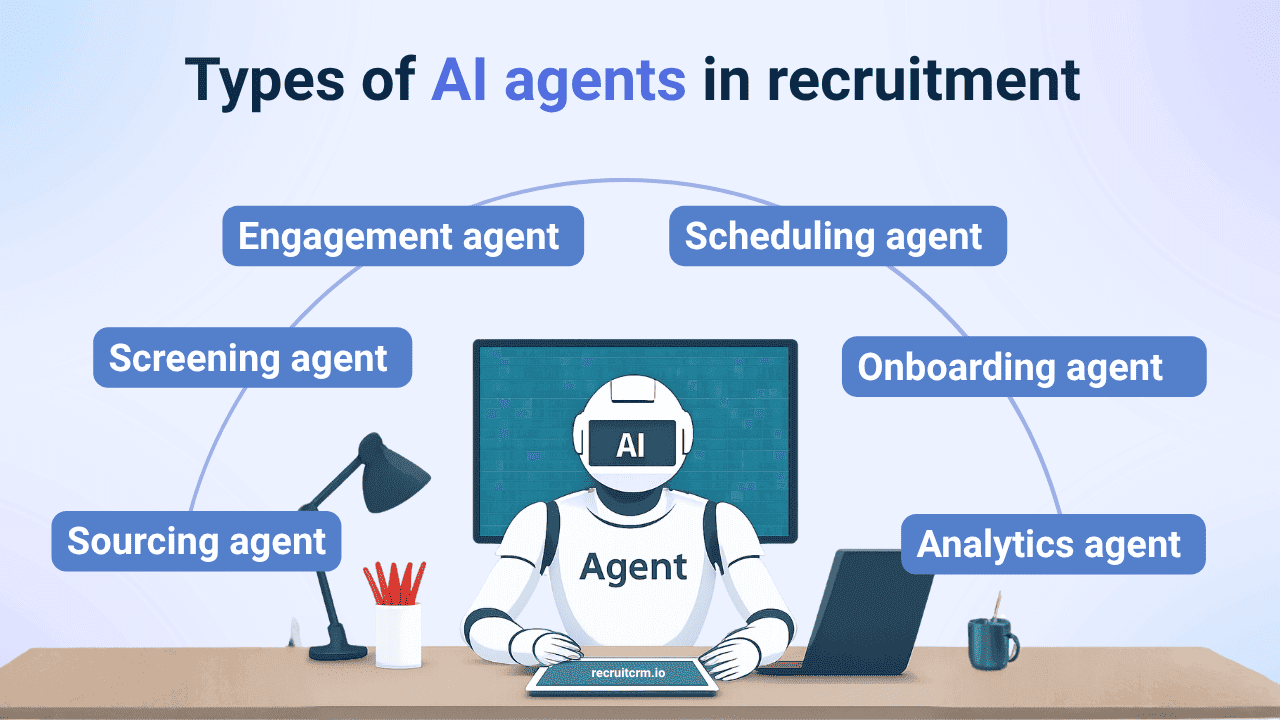
What are the different types of AI agents in recruitment?
1. Candidate sourcing agent
Candidate sourcing AI agents work as your digital assistants to help you find potential candidates.By leveraging their ability to quickly scan your recruitment databases, job boards, and social media platforms, you can conduct active and passive recruitment simultaneously.
To make them work effectively, recruiters need to provide the tool with specific instructions, such as job requirements, primary keywords, and required skills. The AI further scouts the internet to match candidate profiles with the job description and this advancement is closely aligned with how Agentic AI(opens in a new tab) is evolving to perform autonomous recruitment workflows in the future.
2. Resume screening agent
Out of a thousand resumes, these AI agents can quickly scan and shortlist the best ones based on your predefined criteria.This criterion is a set of instructions you provide to program your AI agent for scanning resumes with specific keywords and skill sets. It also helps you to investigate any inconsistencies in candidates' past work experience.
Resume screening agents are the most effective tools for reducing your time and cost per hire and for mitigating bias in the recruitment process.
3. Candidate engagement agent
While candidate sourcing brings the talent to your table, it is the engagement agent that makes the candidates stay for the desserts.These AI agents can be programmed to send personalized messages to candidates, resolve their queries, and keep them in the loop of the hiring process.
To make the best use of these engagement agents, you can integrate them with your preexisting recruiting chatbots and other communication platforms to oversee your communication with your potential candidates.
4. Scheduling agent
When multiple candidates compete for a single position, managing the interview process and analyzing each candidate fairly can become chaotic.AI-powered scheduling agents can help you coordinate with your candidates’ calendars to make the interview scheduling smooth and organized.
With the help of the minutes recorder feature, these agents remain active throughout the process to provide a detailed interview scorecard, which typically includes video transcriptions, a summary, and candidate response analysis.
5. Analytics agent
Analytics agents help you strengthen your talent pipeline by providing data-driven insights that otherwise would be unavailable to you.You can do this by integrating them into your existing ATS or CRM software. Once they have access to your talent database, they work on providing deeper candidate insights by conducting a predictive analysis.
It does so by conducting a predictive analysis of your recruitment data, such as KPIs and candidate success rates. This way, you can retain top employees in your company.
6. Onboarding agent
While other AI agents help you with candidate sourcing, onboarding agents can help you close this search.By giving these agents access to your company policies and software, you can automate administrative tasks such as handling candidate documents and scheduling orientation sessions.
This not only simplifies the onboarding process but also improves the candidate experience, ensuring a smooth transition from hire to active team member.
How to use AI agents in recruitment?
1. Automate repetitive tasks first
AI agents are the best performers for simplifying data-driven, repetitive tasks such as candidate sourcing and resume parsing, as they require no complex decision-making.You can let your AI-powered tools handle such low-value, high-volume tasks first, rather than having them handle the difficult tasks directly.
This will give you enough time to focus on activities that require human judgment, like building candidate relationships and assessing their culture fit. Once you gain a basic understanding of how these AI agents work, you can expand their use for more complex processes, such as predictive analysis and candidate engagement.
2. Supervise your AI agents
AI agents do not require recurrent human assistance.As a recruiter, you should never make the mistake of misunderstanding this definition. While AI agents are automated and do not require constant prompting, they still need human supervision.
They work on programmed algorithms, which makes them inadequate to assess the cultural fitness of candidates. This makes it essential for you to always review the work done by your AI-powered software, be it candidate sourcing or curating personalized emails.
3. Feed your tools with rich data
AI agents use historical data and patterns to work effectively. If you feed the AI some poorly structured data, it becomes programmed to make poor decisions.To avoid this, you need to make sure that your job descriptions, candidate profiles, and selection criteria are well-defined and consistent.
Additionally, you can always keep your unconscious bias in check while cross-checking the shortlisted candidates. Unfair candidate selection can cause the AI agent to shortlist the wrong talent in the future.
4. Monitor, measure, and retrain your agents regularly
There's no doubt that AI agents are smart, but they are not smart enough to upgrade themselves.You need to constantly monitor their performance and retrain them to ensure their improvement.
Their performance success can be measured by predefining certain metrics, such as conversion rates, candidate feedback, and overall hiring timelines. These metrics can be tracked and evaluated to see if your recruitment tool is delivering the expected results.
If you fail to retrain your AI agents, they might stop giving you successful results. To avoid this, expose them to fresh real-world data followed by revised feedback to reboot their functionality.
5. Prioritize candidate experience
Enhancing candidate communication is a basic function of an engagement agent, but you can make the most of it by using it wisely.Start by letting your candidates know that they are interacting with an AI agent to establish transparency. This makes your candidates feel valued while enhancing your employer brand among the talent pool.
To further enhance the candidate experience, give greater emphasis to human communication during the later stages of the hiring process. Avoid using AI agents to communicate rejections or final hiring decisions. This creates a sense of empathy and personalization that candidates commonly expect.
AI agents FAQs
1. Which AI agent platform is best for enterprises?
Defining the best AI agent for enterprises can be difficult, as the ideal platform varies by company. It depends on their needs, size, and available budget.Since many enterprises have many hiring needs, it’s often better to invest in a comprehensive solution. They can benefit from modern platforms like Recruit CRM, which offer a Workflow Automation feature. It allows you to create custom workflows that eventually act as AI agents. This helps you streamline your tasks without having to use multiple agents.
2. What is the difference between AI tools and AI agents?
AI tools for recruitment are designed to perform specific hiring tasks based on the instructions provided by the users.AI agents, on the other hand, work autonomously by using reasoning to make decisions and manage various recruitment tasks. Unlike AI tools for recruitment, they do not require constant user intervention.
3. What are the limitations of AI agents?
The following are the major limitations of AI agents in recruitment that you should be aware of:- AI agents lack human judgment and soft skills.
- Though AI agents give unbiased results, they can often replicate the user's bias.
- Not every AI agent integrates with all HR systems.
- As AI systems collect vast amounts of candidate information, securing this data can become difficult.
4. Can AI agents support diversity in hiring?
Yes, AI agents can help improve diversity by reducing bias during candidate shortlisting. They focus entirely on the candidates' skills and qualifications. However, the AI agent can often mimic their users' unconscious bias. To avoid this, it is important to retrain your AI agents once in a while.5. How do AI agents in recruitment work?
AI agents in recruitment mainly focus on four tasks. They are as follows:- Sourcing: They scan job boards and social media to identify potential candidates based on specified criteria.
- Screening: AI agents evaluate resumes and applications, ranking candidates by relevance and qualifications.
- Engagement: They automate communication, sending personalized messages to candidates and scheduling interviews.
- Matching: AI agents match candidates with job openings by analyzing resumes, job descriptions, and previous hiring data.
6. What is the future direction of AI agents?
Given current improvements and features, AI agents in recruitment will likely focus on enhancing the software's personalization and predictive capabilities in the future. With the help of natural language processing and machine learning, they will be able to assess soft skills, cultural fit, and even emotional intelligence. Additionally, AI will increasingly integrate with other HR tools, making recruitment more efficient.Summary
This blog helps recruiters understand the basic definition of AI agents in recruitment. It aims to inform them about different types of AI tools. Additionally, the blog provides expert advice on how recruiters can make the best use of their AI agents. In the end, the blog answers various frequently asked questions regarding AI agents.


Get 20% commission on cash collected per month from every customer you refer for upto one year.
Join Recruit CRM’s affiliate program and start making money.
Categories
Stay ahead with the smartest
recruitment newsletter out there!
Join 30K+ recruiters reading the best newsletter in recruitment.