

Social recruiting 101: A complete guide for 2026
Social recruiting means using social media to attract and engage candidates, build an employer brand, and reach potential hires. Key strategies include sharing employee stories, running targeted ads, using video content, hosting webinars, leveraging employee advocacy, and building a talent community.It's been almost a week since you posted an opening on that job board. Wondering why you haven’t heard from any candidates yet?
This is because job seekers spend most of their time on digital platforms rather than job boards. Most of the job seekers use social media to stay updated on current job openings.
That's why many recruiters have now started using social platforms for recruitment, but very few are actually doing it right. Keep on reading this blog to find out the correct way to nail social recruiting!
What is social recruiting?
To put it simply, social recruiting means using social media platforms like LinkedIn, Twitter, Instagram, Facebook, etc, to identify, engage, and hire the best candidates.Sure, you can do cold calling and everything, but social recruiting helps you tap into vast networks where job seekers are already active, making it a direct route to some of the most qualified and engaged talent.
It includes creating a more personalized hiring experience and being present on platforms where candidates are looking for both job opportunities and industry connections.
Why should recruiters start social recruiting?
 1. Increases brand visibility and employer branding
Social recruiting allows you to stand out from the crowd in a way that traditional methods can’t. Potential candidates get to see what it is like to work with you when you post about your company on social media. It can be posts showcasing team achievements, sharing employee stories, or highlighting company culture.
This approach makes your company more relatable and approachable. Building an authentic digital presence helps you attract applicants who are genuinely aligned with your values and work culture.
As a result, you’re filling positions as well as creating a community of job seekers who already feel connected to your brand even before they apply.
2. Gives access to a larger talent pool
With online networks, you have an opportunity to reach candidates who might never have seen your job listing through conventional channels.Social media platforms(opens in a new tab) like Facebook, Instagram, LinkedIn, and Twitter open up a global talent pool for you.
But what's even better is that social recruiting lets you tap into this talent based on more than just a resume. You can find candidates who engage with your content, interact with your brand, and show an interest in what you do.
The ability to target specific audiences based on location, job interest, and skills means you're focusing your efforts on finding the perfect fit for your role.
3. Enhances candidate engagement and experience
When you engage with candidates directly on the social platforms they use daily, you make the interaction feel more like a conversation than a transaction.Responding to comments, answering questions, and acknowledging interest helps turn a cold application into a warm exchange.
This way, you build trust and show the applicants that you value their time and effort.
So even if they don't make it to the final interview, they’re more likely to share their positive experience and may even apply again in the future.
4. Optimizes hiring cost
One of the biggest challenges with traditional recruitment methods is the recruitment cost.Job boards, headhunters, and recruitment agencies all come with hefty price tags. But that doesn’t apply to social recruiting.
Many platforms, like LinkedIn and Facebook, allow you to post jobs for free, reaching thousands of candidates without spending a single penny.
When you do choose to invest in paid ads, social media offers highly targeted options to ensure your money is spent efficiently.
You can pinpoint the exact candidates you're looking for based on location, interests, skills, and more. Plus, tracking your campaign’s success in real-time lets you adjust your approach as needed, ensuring you're always getting the best return on investment.
6 social recruiting tools to simplify your hiring process
1. Recruit CRM
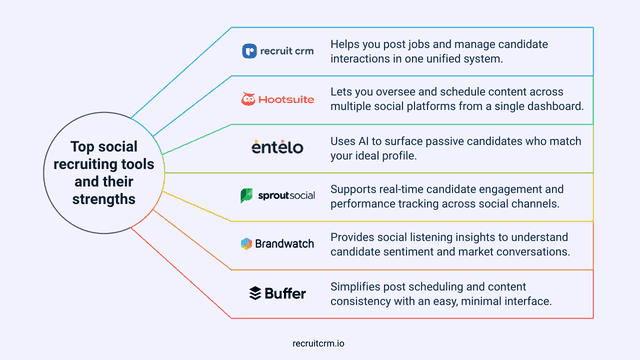
Recruit CRM is an all-in-one tool that blends social media integration with CRM functionality.It’s perfect for recruiters looking to manage talent pipelines while posting jobs across various social media platforms(opens in a new tab).
The platform's intuitive interface features, like a Kanban board, let you stay organized by syncing candidate data across platforms. This seamless connection between CRM and digital platforms reduces manual tracking and frees up a lot of your time.
A standout feature of Recruit CRM is its ability to simplify the entire recruiting process by bringing together your candidate interactions and social media outreach in one place.
2. Hootsuite(opens in a new tab)
To ensure that you are not overwhelmed with the task of managing multiple social platforms, Hootsuite allows you to schedule social media posts, monitor engagement, and track the performance of your job listings, all in one place.This platform gives you a comprehensive view of how your social recruiting campaigns are performing. It's ideal for teams looking to engage with candidates across various channels like Facebook, Twitter, and LinkedIn simultaneously, as it allows for easy coordination and data-driven recruitment.
3. Entelo (Now part of Rival hr)(opens in a new tab)
Entelo’s strength lies in identifying people who may not be looking for a new role but fit your criteria based on skills, experience, and online activity.The platform helps you discover talent you wouldn't find through traditional candidate sourcing by analyzing public data across social platforms and professional sites.
It also provides recommendations based on the likelihood that a candidate will respond. This helps you avoid investing time in outreach that might go nowhere. Recruiters who want to shorten their sourcing time often find Entelo helpful as it speeds up the research process significantly.
4. Sprout Social(opens in a new tab)
Real-time engagement is a major advantage in social recruiting, especially when candidates ask questions or comment on job posts. Sprout Social gives you a structured way to engage with them in real time. You can respond to questions, monitor mentions of your brand, and track how different types of posts perform.It also offers an organized reporting system that highlights what’s working and what isn’t. The tool makes it easier to build a predictable social recruiting workflow by clearly showing which content formats and platforms drive interest from potential candidates.
5. Brandwatch(opens in a new tab)
How candidates perceive you shapes your entire recruitment strategy. Brandwatch provides powerful social listening tools to monitor online conversations about your company. It excels at providing insights into market trends, competitor activity, and candidate sentiment.The platform also tracks broader industry chatter. If a new trend is emerging or if candidates in your niche are shifting preferences, the tool can highlight these patterns. You can use these insights to shape your social media strategy(opens in a new tab).
6. Buffer(opens in a new tab)
Buffer keeps things simple for recruiters who want a clean, easy way to publish and track posts across social channels. You can line up job postings, culture updates, and hiring announcements in advance and let the tool handle distribution.The software also provides clear metrics for each post, which can be helpful if you are building your social recruiting presence from scratch and want quick feedback on what engages candidates.
What are the best social recruiting strategies?
1. Create a strong employer brand on social media
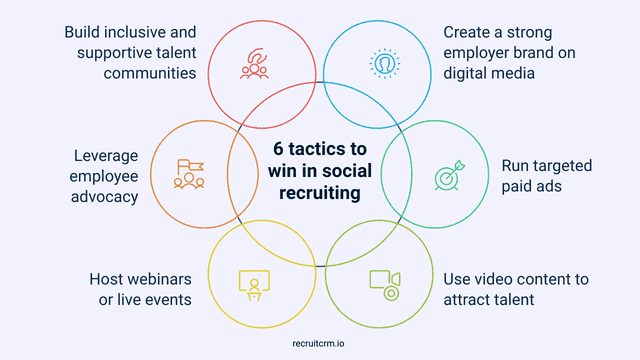
Employer branding has become one of the biggest deciding factors for candidates. A recent study found that 75 percent of job seekers(opens in a new tab) consider an employer’s brand before applying, and companies with strong employer brands experience more qualified applicants and lower cost per hire.Candidates often compare multiple agencies before responding to outreach, and your online presence becomes the first impression they see. Get support from social media experts(opens in a new tab) to help increase your brand’s authority.
You can share consultant achievements, real candidate success stories, or day-in-the-life clips to help job seekers understand how you operate. Also, create a QR code to redirect readers to your company’s activity page.
2. Run targeted ads and sponsored posts
There is no point in posting ads everywhere in the dark if they are not reaching their target audience. Targeted recruitment ads improve the relevance of applicants and significantly reduce wasted ad spendRefine audiences based on skills, certifications, seniority, career stage, or even recent job changes. See where your target viewers are most active. For example, Talented developers can be found on platforms like GitHub and Stack Overflow Jobs.
In a startup, tech resources already consume a significant portion of the budget, and the company must rely on its tech employees to achieve fruitful and consistent outcomes especially when working with top .net developers(opens in a new tab), thus social recruiting can help in increasing hiring efficiency with respect to developers and even other fields.
What you might often overlook is the retargeting potential. These individuals clearly have an interest in your company, and you should retarget them to seal the deal. Social ads can be shown to: • People who visited your career page • People who watched 50 percent of your previous videos • Candidates who engaged with a job post but didn’t apply
3. Use video content to attract candidates
Meta reports that videos show 5x better performance(opens in a new tab) than images in engagement on Facebook and Instagram. Grab this opportunity to explain roles and workplace environments to candidates in a format they prefer consuming. A QR Code Generator can help you turn those videos into scannable links on job posts, emails, or offline materials, making it effortless for candidates to watch them instantly.Many job descriptions sound similar, but a short hiring manager clip covering what the role solves, what tools they’ll work with, how the team collaborates, and what success looks like in month one will outperform even the best-written job advertisement.
And don’t worry, you don’t need a studio setup. You can use corporate video production (opens in a new tab)services to create neat content. Platforms like Instagram and TikTok reward raw videos because they feel more human. Using the right social media tools(opens in a new tab) can also help you organize and publish videos more smoothly.
4. Host webinars or live events for recruitment
Webinars and live sessions have become increasingly valuable in recruitment because they give candidates direct access to real people. When candidates can join a short session and hear from recruiters, hiring managers, or industry experts, they gain clarity that written descriptions don’t provide.These sessions work especially well when you focus on topics candidates genuinely care about, such as:
- Shifts happening in their industry
- Skills employers are prioritizing
- Realistic salary expectations
- Tips to navigate interviews or candidate assessments
Live events also reduce uncertainty.
Candidates often hesitate because they don’t fully understand a role or the hiring process. Answering their questions in real time and explaining the workflows makes them more confident and helps resolve their concerns.
5. Leverage employee advocacy for social recruiting
Employee-driven content resonates more with audiences than content directly posted by brands. Posts shared by employees lead to 60% higher engagement(opens in a new tab) than that of corporate accounts.Encourage your team to share job openings and company updates. Candidates are more likely to trust a post from a team member than one from an anonymous company profile.
Employee advocacy also improves your agency’s credibility. When consultants share their personal experiences, insights into the job market, or roles they’re directly working on, it strengthens the connection with potential candidates.
To increase participation, make it easy for your team to share content. Providing pre-written templates, weekly updates, or simple captions that they can personalize ensures that sharing becomes a part of their routine.
6. Build a talent community through social media
Building a talent community helps you create long-term relationships that benefit both your agency and potential future hires.Candidates think of you as a reliable resource when you create a community that shares useful information and helps each other.
Here are a few pointers you can keep in mind when you create your first community -
- Start small and grow your community: Start by engaging with a few key candidates. Share helpful content, and ask for feedback. Gradually, word will spread, and your community will grow naturally.
- Share more than just jobs: Use platforms like LinkedIn and Instagram to post about professional growth, advice from past candidates, or highlights of your team’s work culture. Content like “Career Tips Tuesdays” or “Hiring Manager Insights” gradually builds trust.
- Create a 'hidden' community: Build a smaller, more exclusive group on LinkedIn or Slack where you share industry trends, webinars, and even interview-preparation resources. Candidates feel more valued if they are a part of an invite-only group.
- Be proactive with your engagement: Use social media to interact with candidates regularly. A quick comment on a post or sharing an interesting article shows you’re genuinely interested in building connections.
Which recruitment KPIs should you track in social recruitment?
1. Measuring engagement: likes, shares, and comments
Engagement is often the first sign that your content is resonating with the right audience. Likes, shares, and comments are great indicators that your posts are reaching the people you want to reach.But don’t just look at the numbers in isolation. The quality of the engagement matters just as much as the quantity. Are people leaving thoughtful comments, or are they simply liking the post? Are candidates sharing your posts with their network, or are they scrolling past?
You can also use social listening tools to track comments and interactions beyond your posts to identify what candidates are saying about your brand. Refine your approach so that your posts resonate with candidates who fit your roles.
2. Conversion metrics: click-through rates (CTR) and application rates
While engagement is a great sign that your content is catching attention, the ultimate goal is to convert that interest into actual applicants. Conversion metrics like click-through rate (CTR) and application rate indicate how well your content motivates candidates to take the next step.CTR shows how often people are clicking through to your job listings or career page from your social media posts. The application rate tells you how many of those who clicked actually went ahead and applied.
Say your CTR is high but your application rate is low; it’s time to rework the content. Check if the call to action is clear or if the job description matches candidate expectations. A/B test your job descriptions and CTAs to find out which phrasing or structure works best for encouraging applications.
3. Cost per hire and time to fill
These two metrics are crucial for measuring the ROI of your social recruiting campaigns and understanding how efficiently you're hiring.Cost per hire is the total cost of recruiting for a role, including ads, tools, time spent by your team, and any external resources, divided by the number of hires made. A low cost per hire means you're sourcing quality candidates efficiently and using resources wisely.
Time to fill measures how long it takes from the moment a job is posted until a candidate accepts the offer. A shorter time to fill indicates an efficient recruiting process, while a longer time suggests you need to improve.
Regularly assess your cost per hire and time to fill to ensure your recruitment budget and team efforts are being utilized effectively. If these metrics aren’t improving, consider adjusting your social recruiting strategy.
Frequently asked questions
1. How do I manage negative comments or feedback during a social recruiting campaign?
Don’t get scared when you get negative feedback. It is actually an opportunity to demonstrate your company’s professionalism and commitment to candidate experience. Handling criticism constructively helps maintain a positive image of your brand.When a negative comment or criticism appears, avoid reacting impulsively. Start by acknowledging the concern to show the candidate you’re listening and genuinely care about their perspective. Offer a solution or explain how you’re addressing the issue to turn a negative interaction into a positive one.
2. What are some effective ways to use Instagram for recruiting?
Instagram is a powerful platform for showcasing your company's human side. It allows you to create a visual narrative of your workplace culture and values. Instagram’s visual appeal also lets you showcase your company’s personality.To stand out, share behind-the-scenes looks at your office, team events, or company culture on Instagram Stories. You could also create highlights that feature employee testimonials or job roles you’re currently hiring for.
Another great strategy is leveraging Instagram’s hashtag feature to expand the reach of your posts. Hashtags like #HiringNow, #LifeAt[YourCompany], or industry-specific tags can attract candidates who are already interested in your niche.
3. How often should I post recruitment content on social media?
Finding the right balance in frequency can be a bit tricky. Posting 2-3 times a week is a good rule of thumb for maintaining visibility without overwhelming your followers.Keep in mind that your social media presence should be varied, so while one post might showcase an open position, the next could highlight employee achievements or company culture.
Blog summary
Social recruiting is a powerful strategy for modern-day recruitment. By leveraging social media platforms like Instagram, LinkedIn, and Twitter, recruiters can build stronger connections with candidates, enhance employer branding, and access a wider, more diverse talent pool.Key strategies include sharing valuable content to build trust, fostering a talent community, leveraging employee advocacy, using targeted ads to reach specific candidates, and creating engaging video content(opens in a new tab) to showcase company culture.
Metrics such as engagement (likes, shares, and comments), conversion rates (click-through and application rates), and efficiency (cost per hire and time to fill) are essential for measuring the success of your social recruiting efforts.


Get 20% commission on cash collected per month from every customer you refer for upto one year.
Join Recruit CRM’s affiliate program and start making money.
Categories
Stay ahead with the smartest
recruitment newsletter out there!
Join 30K+ recruiters reading the best newsletter in recruitment.