




What actually fills high-demand contract roles?


After a soft 2025, US staffing turned a corner at the end of the year. Staffing firms employed about two million temporary and contract workers a week(opens in a new tab) in the fourth quarter of 2025, up 65,000 on the prior quarter. Businesses that had paused permanent hiring are leaning on contract and temporary specialists to keep projects moving.
That demand is only good news if you can fill the roles. And the highest-demand contract roles, the specialist and project-shaped ones, are exactly the roles that sit open the longest.
The reason is rarely a shortage of resumes in your database. It is that most of us match people to contract roles by job title, when the skill is what actually fills the role.
Key takeaways
- US employers are leaning on flexible talent again: staffing employment rebounded in the fourth quarter of 2025 to about two million temporary and contract workers a week(opens in a new tab).
- ManpowerGroup finds 69% of US employers(opens in a new tab) cannot find the skilled people they need, and globally, the scarcest skills sit in AI, data, and IT, the disciplines most often hired on contract.
- High-demand contract roles stay open because recruiters match candidates based on job titles and resume keywords rather than the specific skills the contract requires.
- Skills-based matching is now mainstream, and TestGorilla finds it works: 85% of employers(opens in a new tab) use it, two in three say it cuts mis-hires, and three in five say it speeds up hiring.
- A repeatable four-step method- map, then pool, then score, then shortlist- fills specialist contract roles faster than title-matching.
Why do high-demand contract roles stay open?
There are two things that keep the hardest contract roles open. One of them is the talent shortage everyone talks about, but the other one often goes unnoticed.The shortage is real, and it is concentrated
69% of US employers cannot find the skilled talent they need, according to ManpowerGroup's 2026 US survey(opens in a new tab), broadly in line with the 72% in its global research(opens in a new tab).Globally, the hardest skills to fill in 2026 are AI development, AI literacy, and IT and data, with AI literacy and engineering also among the toughest for US employers. The World Economic Forum reports that 63% of employers(opens in a new tab) name the skills gap as the single biggest barrier to business change.
Look at what recruiters actually get briefed on, and the pattern is sharper still. The contract roles businesses hire for cluster around IT and data, project and program delivery, finance, compliance, and specialist engineering. These are the project-shaped skills a business will not carry on a permanent payroll but urgently needs for a defined piece of work.
Title-matching is the hidden reason roles go unfilled
The shortage explains why a role is hard to fill. Title-matching explains why it stays open. Search your database for "Business Analyst" or "PMO Manager," and you surface people whose last job title matched the search, when the contract turns on a specific set of skills.A contract role is defined by its deliverable: a migration, a remediation, a system rollout. Two candidates with the identical job title can be a perfect fit and a hopeless one, and a keyword search cannot tell them apart.
So a role stays open while a genuinely qualified contractor sits uncontacted in the same database. With US job openings still at 7.6 million as of May 2026(opens in a new tab), the market is full of vacancies; what's scarce is the match.
A skills-matching strategy that actually fills contract roles
The fix is to match on skills rather than titles, and to do so consistently every time.Here is the four-step method your team can use to fill specialist contract roles. It goes a level deeper than this helpful contract-staffing primer, and it maps onto the way skills-based hiring is measured to work.
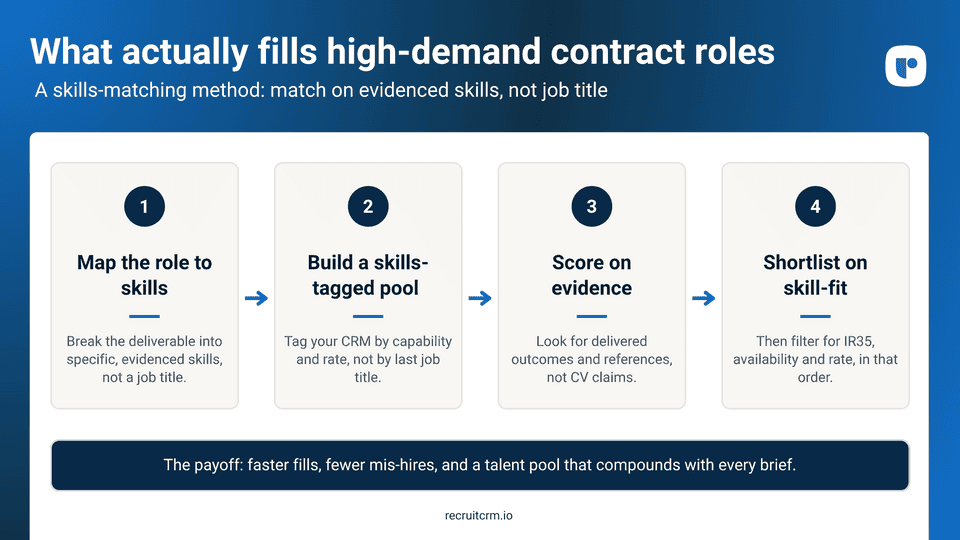
Step 1: Map the role to skills
Start with the deliverable and work your way back. Ask the client what the contractor has to have done by the end of the assignment, then break that into the specific, evidenced skills the work requires(opens in a new tab): the tool, the regulation, the methodology, the sector.Take an anti-money-laundering contract role. Behind that one title sit three distinct requirements: transaction monitoring experience, a specific sanctions and watchlist tool, and a particular regulatory regime. A candidate can hold two of the three and still be wrong for the assignment.
Write the skills down as your match criteria before you open the database. That list is what you are genuinely recruiting against, and it is far more precise than any job title a search box can match.
Step 2: Build a skills-tagged talent pool
Talent-matching fails partly because your system is looking for a title match rather than a skill match. As you meet contractors, record the specific skills, tools, sectors and outcomes they can evidence, along with their availability and rate, rather than filing them under their last job title.A searchable, skills-tagged talent pool in your recruitment CRM turns a database of names into a database of capabilities you can search against your set criteria. It is the single change that does most to shorten your next search, because the matching work is already done before the brief lands.
The first time a niche brief comes in and three genuine matches are already sitting in your pool, the effort of tagging pays for itself.
Step 3: Score candidates on evidence of the skill
For each criterion, look for evidence rather than assertion using competency-based interviews(opens in a new tab). A skill listed on a resume is a claim; a delivered outcome, a credible reference, or a short skills check turns that claim into something you can stand behind with a client.Skills-based hiring works for exactly this reason: testing for skills cuts mis-hires and speeds up hiring(opens in a new tab), the two outcomes a contract desk lives on.
Contract work rarely needs heavy testing. Ask a shortlisted business analyst to walk you through a requirements conflict they resolved, or a compliance contractor to walk you through a remediation they led. That usually separates the real match from the title match in minutes.
Step 4: Shortlist on skill-fit and context
Rank on skill-fit first. Only then apply the practical filters that make or break a contract placement: start date availability, pay rate, and worker classification.Classification determines whether the contractor is engaged as a W-2 employee on an agency's payroll or as a 1099 independent contractor, and it shapes who will take the role and at what rate. Get it wrong, and you expose the client to IRS and Department of Labor penalties and co-employment risk.
Apply that context after skill-fit, never before, or you risk cutting the one person who could actually deliver because their rate looked high at first glance.
Does skills-based matching actually work?
Skills-based hiring is now the mainstream approach: TestGorilla puts it at 85% of employers in 2025(opens in a new tab), up from 81% the year before. The outcomes are the part that matters for a contract desk:- Two in three employers say skills testing has reduced mis-hires.
- Three in five say it has shortened time-to-hire.
- 53% have dropped degree requirements, widening the pool you can draw on.
A client turning to contract usually cannot wait that long, and skills-first matching is how you fill in days rather than months.
How to measure whether your matching is working?
You have put in all the effort, but how do you know if it's working? You need to focus on these four metrics to know if you are getting the returns on the steps you are taking:- Time-to-fill: days from brief to accepted offer. Skills-first matching should pull this down.
- Fill rate: the share of briefs you actually place. This is the number that grows a contract desk.
- Mis-hire and early-termination rate: contracts that end early or need to be replaced. Evidence-based matching should shrink it.
- Redeploys from your pool: placements sourced from your skills-tagged pool rather than a cold search. A rising redeployment rate means Step 2 is compounding.
Common mistakes when matching for contract roles
You measure the impact of your efforts, and you notice a gap. Does that mean the approach is totally wrong for your agency? Not really! You might be making these small mistakes which are causing your loss:- Matching the title instead of the deliverable. Same title, opposite fit; only the deliverable tells them apart.
- Leading with rate. Filter on pay rate before skill-fit, and you rule out the very contractor who would have earned that rate back in the first week of the assignment.
- Ignoring classification until the offer. W-2 or 1099 status changes who will even accept the role, so confirm it early, before the shortlist is built.
- Treating a contract like permanent. Contract hiring is judged on speed and precision. A slow, perm-style pipeline with three rounds of interviews hands the placement to a faster desk while you are still arranging the second one.
Frequently asked questions:
1. What are contract roles?
Contract roles are fixed-term, deliverable-focused positions where a business engages a specialist for a defined piece of work or period, rather than hiring a permanent employee. They are common in project, technology, finance, and change work, and are usually filled quickly to close a specific skills gap.2. What is the difference between contract and permanent recruitment?
Contract recruitment fills a defined-term role built around a specific outcome, usually at speed, and prizes evidenced, ready-now skills. Permanent recruitment fills an ongoing role, weighs long-term fit and progression, and can afford to invest in potential and development over time.3. What is a contract-to-hire role?
Contract-to-hire roles are fixed-term assignments that include an agreed path to a permanent offer, allowing the business and the contractor to test the fit before either commits.The worker is usually engaged through an agency for the contract period, then converted to a permanent employee if both sides want to continue.
4. How does contract-to-hire work?
Contract-to-hire works in two stages: the agency places the candidate on a fixed-term contract, then the client converts them to permanent after an agreed period or by paying a conversion fee. For recruiters, it lowers the client's risk and can create a second fee at conversion.


Blog written by
Auria Heanley
Co-founder at Oriel Partners
Auria Heanley is co-founder of Oriel Partners, a temp agency serving London and the UK. She is extremely passionate about providing the highest quality of service to both clients looking to hire temp staff and candidates looking for a temporary role. Oriel Partners’ clients range from global multinationals to small boutique firms, all requiring the same personal service and high-caliber support. If your business needs specialist temporary and contract recruitment handled this way, that is the work we do every day.
Stay ahead with the smartest
recruitment newsletter out there!
Join the recruiters who never miss what’s next.




![How to master effective candidate communication? [Free outreach templates inside]](/static-assets/_next/image/?url=https%3A%2F%2Frecruitcrm.io%2Fwp-content%2Fuploads%2F2023%2F05%2FThumbnail-httpsrecruitcrm.ioblogscandidate-communication-1.png&w=828&q=75)

![Do you use the best recruitment marketing tool? [Top 10 list]](/static-assets/_next/image/?url=https%3A%2F%2Frecruitcrm.io%2Fwp-content%2Fuploads%2F2025%2F05%2FThumbnail-_-https___recruitcrm.io_blogs_top-recruitment-marketing-tools-2.png&w=828&q=75)


![2025 recruitment industry review [+ 2026 hiring trends]](/static-assets/_next/image/?url=https%3A%2F%2Frecruitcrm.io%2Fwp-content%2Fuploads%2F2024%2F12%2FThumbnail-2025-recruitment-industry-review-2026-hiring-trends-1-1.png&w=828&q=75)






 marketing@recruitcrm.io
%201.4700f78c.svg&w=32&q=75) Workforce Cloud Tech, Inc. 28 Mohawk Avenue, Norwood, NJ 07648.
Workforce Cloud Tech, Inc. 28 Mohawk Avenue, Norwood, NJ 07648.


