The ultimate guide to 125+ job boards worldwide


Recruiting isn't just about finding the right candidates; it's about timing. Job boards bridge exactly this gap by connecting recruiters with job seekers.
These digital platforms connect recruiters with job seekers, bridging the gap between opportunity and talent.
Our exclusive global job board guide to 125+ job boards globally offers everything you need to master this process.
From free platforms to niche job sites, this resource will help you discover the best options to amplify your hiring efforts.
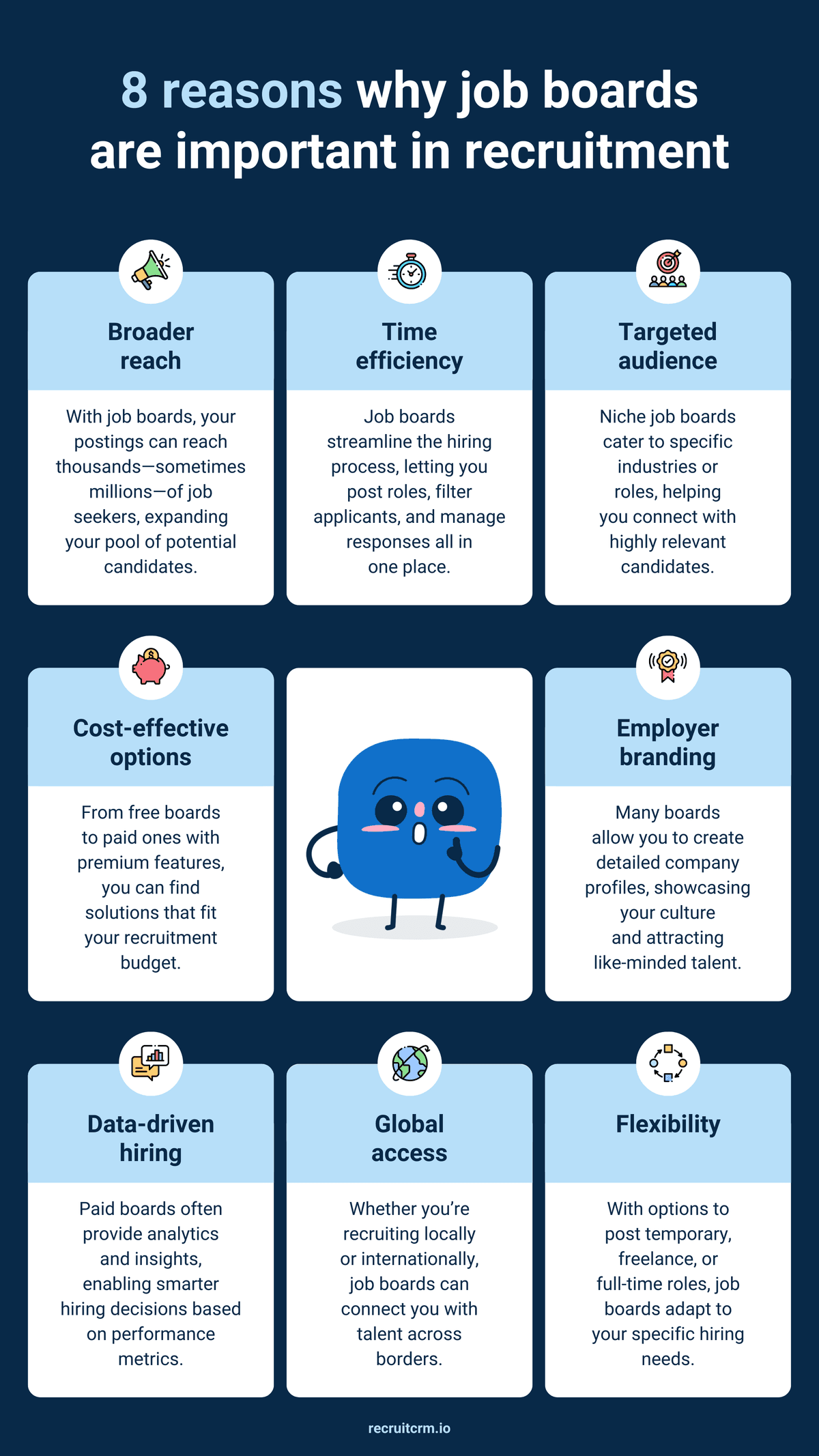
8 reasons why job boards are a must-have in recruitment
1. Broader reach
One of the biggest advantages of job boards is their ability to give your job postings unparalleled visibility.
With a single listing, you can reach thousands—sometimes even millions—of job seekers across different locations and industries.
Whether you're a small business looking for local talent or a multinational seeking candidates globally, job boards provide a platform to connect with a diverse and expansive pool of potential hires.
Leveraging this broad reach, you can ensure that your job postings attract not just a high volume of applicants but also a variety of skill sets, experience levels, and perspectives.
2. Time efficiency
Recruitment is often a time-sensitive process, and job boards make it easier to post roles, filter candidates, and manage applications quickly.
Most job boards come with built-in tools that automate repetitive tasks like sorting resumes or sending automated responses to applicants.
For recruiters juggling multiple positions, job boards act as a centralized hub where you can handle all your postings and applications in one place, saving valuable time that can be used to focus on interviewing and selecting the right talent.
3. Targeted audienceWhen you're hiring for specialized roles, niche job sites are a game-changer.
These platforms cater to specific industries, skill sets, or professions, ensuring that your postings are seen by the most relevant candidates.
For specialized roles, niche job sites like Dribbble (for creatives) or TechCareers (for IT professionals) allow you to connect with candidates who meet your exact needs.
For example:
- A job board like Dribbble is ideal for designers and creatives.
- TechCareers focuses on professionals in technology and engineering.
- eFinancialCareers connects you with finance and banking experts.
4. Cost-effective options
Recruitment can be expensive, but job boards offer scalable options to suit every budget.Many platforms, like Indeed(opens in a new tab) or SimplyHired(opens in a new tab), allow you to post jobs for free, making them accessible to startups and small businesses.
For companies willing to invest in premium features, paid job boards provide advanced options like sponsored listings, detailed analytics, and better visibility.
This flexibility ensures that recruiters can maximize their return on investment, regardless of the size of their hiring budget.
5. Employer branding
Today’s job seekers don’t just look at the role—they look at the company behind it. Job boards often allow you to create comprehensive company profiles, complete with your mission, values, and culture.Platforms like Glassdoor(opens in a new tab) even include employee reviews, which help potential candidates understand what it’s like to work for your company.
This transparency builds trust and attracts like-minded talent, strengthening your employer brand.
6. Data-driven hiring
Paid job boards often come equipped with analytics tools that provide insights into your hiring performance. You can track:- How many people viewed your job posting.
- The number of applicants who started and completed their applications.
- The effectiveness of your job description or ad placement.
7. Global access
Global recruiting is made easier through job boards, which provide unparalleled access to talent across regions and industries.
Many platforms cater to specific regions or countries, such as Reed.co.uk in the UK, GulfTalent in the Middle East, or SEEK in Australia and New Zealand.
This global access allows you to build diverse teams and tap into talent markets that might otherwise be hard to reach, giving you a competitive edge in sourcing top-tier candidates.
8. Flexibility
Job boards are designed to cater to a variety of hiring needs, whether you’re looking for full-time employees, freelancers, or temporary staff.Many platforms also offer features like:
- Filters for specific employment types.
- Options to post remote or hybrid roles.
- Tools to repost or refresh listings based on evolving hiring requirements.
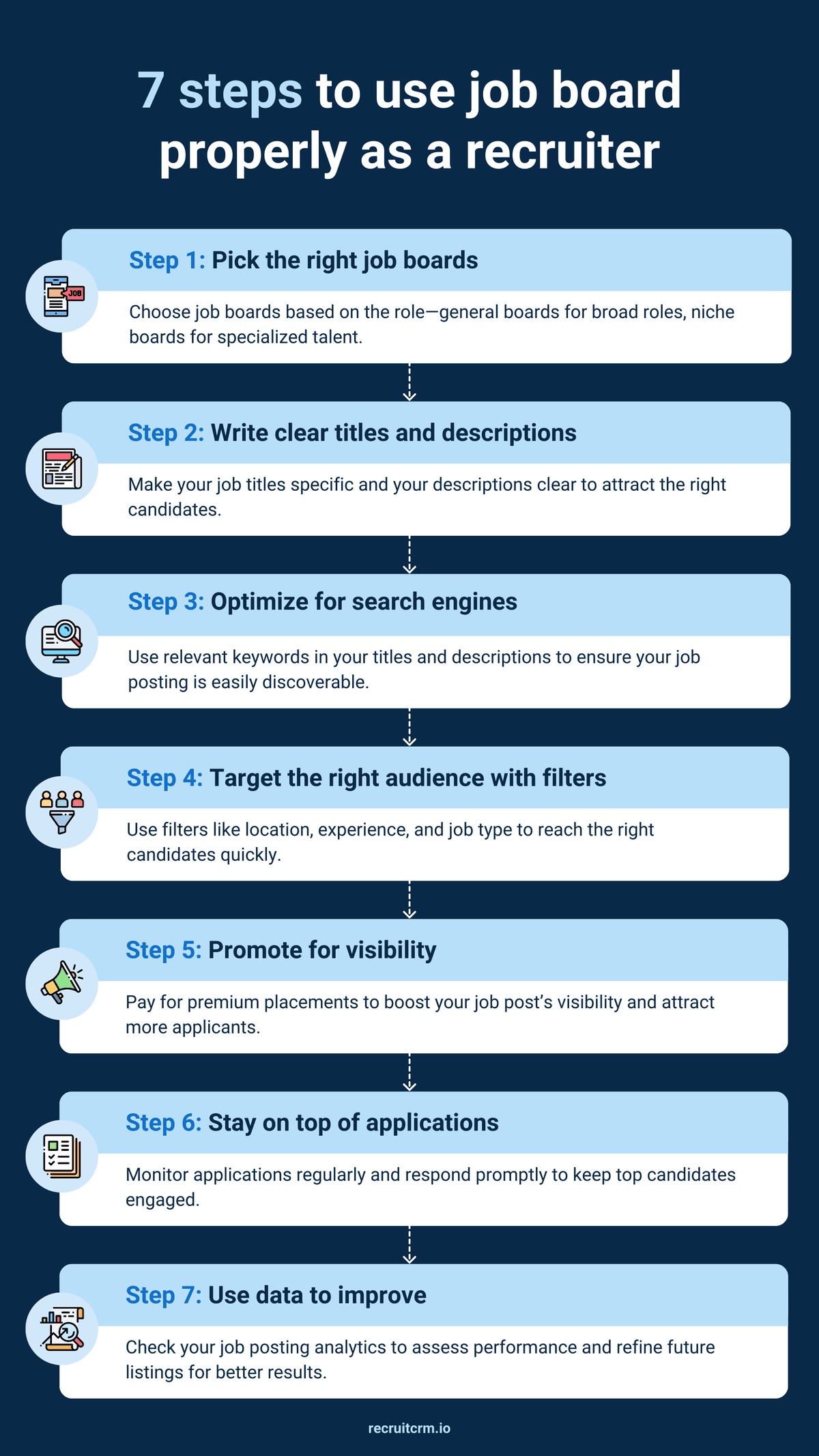
7 steps for successful global recruiting using job boards
1. Pick the right job boards for your needs
First things first: not all job boards are created equal.
If you're hiring for general roles, platforms like Indeed or LinkedIn might be your go-to.
But if you're looking for specialized talent—whether it's tech experts, creatives, or finance professionals—look into niche job sites like Dribbble or eFinancialCareers.
Think about what type of candidates you need, where they hang out, and choose your boards accordingly. It's all about being strategic from the get-go.
2. Write clear, catchy job titles and descriptions
Once you’ve selected your boards, it’s time to craft your job postings.Make sure your job title is clear and to the point—avoid vague titles like "Marketing Guru" or "Tech Rockstar" and opt for something straightforward like "Senior Marketing Manager" or "Software Engineer."
When it comes to descriptions, be specific.
Highlight key responsibilities, necessary skills, and the type of person you’re looking for.
Candidates should know exactly what to expect and whether they’re a good fit for the role. The more transparent you are, the better the quality of applicants.
3. Optimize for search engines
Want your job postings to be found?Then make sure they’re optimized for search engines!
This is key whether you're using a job board’s internal search engine or external platforms like Google.
Include relevant keywords in the job title and description—things like "remote," "marketing," or "data analyst"—that job seekers are likely to search for.
A little SEO goes a long way in ensuring your posting gets seen by the right people.
💡Pro tip: Use variations of keywords to cast a wider net.
4. Target the right audience with filters
Most job boards come with filters that allow you to narrow down your audience by location, experience level, and skill set.
These filters are gold! Use them to ensure your job listing is reaching the candidates who are most likely to apply.
Some boards even let you filter by employment type (like full-time, part-time, or freelance) or job category (like tech, design, or marketing).
It's an easy way to save time and make sure you're getting applications from candidates who truly match your needs.
5. Promote your post for better visibilityGot a role that needs to be filled fast?
Consider paying for premium placement.
Job boards often offer paid options like sponsored listings or featured jobs that push your posting to the top of search results or make it stand out.
It’s a great way to ensure your job gets noticed, especially when there’s a lot of competition.
If you’re working on a tight timeline or need to attract more candidates, this little investment can make a big difference.
6. Stay on top of your applications
Once your job is live, keep an eye on the applications that come in.Many job boards provide dashboards where you can view resumes, manage applications, and even communicate directly with candidates.
Don’t let your inbox get flooded—stay organized and respond to applicants promptly.
The faster you move, the less chance you have of losing out on top talent.
If you’re juggling multiple roles, it’s essential to stay on top of things.
7. Use data to improve future posts
Lastly, don’t forget to check the performance of your job postings.Most boards provide analytics—such as the number of views, applications, and click-through rates—to help you understand how well your job is performing.
If you’re not getting the results you want, take a step back and analyze what’s going wrong. Maybe your job title is too vague, or your description isn’t specific enough.
Use this data to tweak your future listings, and over time, you’ll get better and better at creating job postings that attract high-quality candidates.
Job board comparisons: 125+ platforms to supercharge your recruitment
Job board comparison: Here's how free platforms like Indeed compare to paid job boards like LinkedIn, and how niche job sites can cater to specialized roles.1. Free job boards
Free job boards are perfect for startups, small businesses, or recruiters on a tight budget.These platforms allow you to post job openings at no cost, ensuring you reach a large audience without overspending.
Despite being free, many of these boards offer tools to optimize your postings.
Examples:
- Indeed(opens in a new tab): The world’s largest job board with millions of active users daily. With free and sponsored listing options, it provides a mix of affordability and flexibility.Why use it? Post jobs for free or boost visibility with paid options, and access resumes to connect with active job seekers.
- Glassdoor(opens in a new tab): Combines job postings with company reviews, helping you attract candidates who resonate with your culture.Why use it? Showcase your employer brand through reviews, salary insights, and detailed company profiles.
- SimplyHired(opens in a new tab): A straightforward platform that aggregates jobs from across the web, making it easy for job seekers to find your listings.Why use it? Free job posting combined with helpful analytics to track performance and refine strategies.
2. Paid job boards
Paid job boards provide enhanced features like premium listings, detailed analytics, and AI-powered matching.These platforms are designed for companies seeking higher visibility and quality candidates.
- LinkedIn Premium(opens in a new tab): A powerful tool for connecting with professionals across industries. With LinkedIn Recruiter, you can send InMail directly to potential candidates.Why use it? Gain access to a global professional network, detailed insights, and advanced filtering options for top-tier hiring.
- Monster(opens in a new tab): Known for its AI-driven matching technology, Monster helps you connect with candidates who align perfectly with your requirements.Why use it? Leverage advanced analytics and a vast resume database to find candidates faster.
- ZipRecruiter(opens in a new tab): Offers smart matching technology and tools for streamlining your recruitment process.Why use it? AI-powered matching ensures your job reaches candidates who are actively looking for roles like yours.
3. Niche job boards
Niche job sites focus on specific industries, skills, or roles. These platforms are a must if you're hiring for specialized positions, as they connect you directly with relevant candidates.- Dribbble(opens in a new tab): A community for creatives, including graphic designers, illustrators, and UI/UX experts.Why use it? Browse curated portfolios and connect with top design talent.
- eFinancialCareers(opens in a new tab): The go-to platform for finance professionals. Find candidates for roles in banking, investments, and financial analysis.Why use it? Specialized tools for hiring in finance ensure your job listings are seen by the right audience.
- TechCareers(opens in a new tab): Tailored for technology and engineering professionals, from software developers to network engineers.Why use it? Directly tap into a skilled talent pool focused on IT and tech-related roles.
4. Region-specific job boards
For businesses looking to expand into specific geographic areas, region-focused job boards are indispensable. They cater to local talent pools while understanding the unique requirements of each market.- SEEK(opens in a new tab) (Australia & New Zealand): The leading platform in these regions, offering job listings across industries and career levels.Why use it? Access advanced tools like salary insights and applicant tracking tailored for the local market.
- Reed.co.uk(opens in a new tab) (UK): A trusted name in the UK, this board provides a wide variety of roles across industries.Why use it? Its CV database and industry-specific categories make finding local talent effortless.
- GulfTalent(opens in a new tab) (Middle East): Specializes in professional roles in the Gulf region, connecting recruiters with top-tier candidates.Why use it? Known for its strong employer branding options and a robust talent pool across industries.
5. Hybrid and freelance platforms
With the rise of remote work and gig economies, hybrid and freelance job boards have become essential for modern recruiters.- Upwork(opens in a new tab): Ideal for freelance projects, connecting you with skilled professionals in design, writing, marketing, and more.Why use it? Manage projects, track time, and pay securely through one platform.
- Fiverr(opens in a new tab): A platform for quick-turnaround freelance tasks, offering services in over 300 categories.Why use it? Find affordable talent for short-term projects with a quick setup process.
- Toptal(opens in a new tab): Known for its stringent vetting process, Toptal connects you with the top 3% of freelancers globally.Why use it? Perfect for high-stakes projects requiring elite professionals.
There’s more to explore
Well, this is just the tip of the iceberg!Get a super detailed, comprehensive overview of each of these 125 job boards in a downloadable PDF for any time, anywhere access.
Each board in the PDF is explored in detail, with specific features, pricing options, and suitability for various recruitment needs.
Download the guide to gain full access:
- From free to paid and niche job sites to global recruiting platforms, every category is included.
- Explore boards tailored to different industries and regions, ensuring the best match for your hiring goals.
- Learn strategies to maximize your recruitment success using these platforms.
Take your hiring process to the next level.
Get the ultimate global job board guide to 125+ job boards worldwide today and start connecting with the best talent worldwide.
Job board best practices for maximum results
Case study: How Global Recruiting through niche job sites helped techcorp find top talent
The challenge: TechCorp, a rapidly growing software company based in Austin, Texas, faced a critical hiring bottleneck in early 2024. Despite posting on popular general job boards like Indeed and Monster for over six months, they struggled to attract qualified senior developers with expertise in machine learning and blockchain technologies. Their traditional recruitment approach was yielding:
- 200+ applications per posting, but only 5-8% were qualified candidates
- An average time-to-hire of 85 days for senior developer positions
- High candidate dropout rates during the technical interview process
- Difficulty finding developers with niche skills in emerging technologies
The Strategy Shift: After consulting with a recruitment specialist, TechCorp decided to pivot their strategy toward niche job sites and global recruiting. They identified three key platforms:
- Stack Overflow Jobs - To target developers already engaged in technical communities
- AngelList - To attract startup-minded developers interested in growth opportunities
- GitHub Jobs - To find developers with proven open-source contributions
Implementation: TechCorp's recruitment team made several strategic changes:
- Refined Job Descriptions: They rewrote their postings to include specific technical stack requirements and highlighted challenging projects involving AI and cryptocurrency
- Showcased Company Culture: On AngelList, they emphasized their remote-first culture and equity participation
- Technical Screening Integration: They linked directly to their GitHub repositories and coding challenges
- Global Reach: They expanded their search to include developers from Eastern Europe and Southeast Asia through these platforms
The Results: Within three months of implementing their niche job sites strategy, TechCorp achieved remarkable improvements:
- 40% reduction in time-to-hire (from 85 days to 51 days average)
- Quality improvement: 60% of applicants met their technical requirements (vs. previous 8%)
- Global talent acquisition: Successfully hired 3 senior developers from Poland, India, and Brazil
- Cost efficiency: Reduced recruitment advertising spend by 30% while improving results
- Cultural fit: 95% of hires through niche job sites passed their 6-month performance reviews
Key Success Factors:
- Platform Selection: Choosing niche job sites where their target candidates were already active
- Content Strategy: Tailoring job descriptions to speak the technical language of their audience
- Global Mindset: Embracing global recruiting opened access to untapped talent pools
- Community Engagement: Actively participating in platform communities rather than just posting jobs
The Takeaway: TechCorp's experience demonstrates that switching from general job boards to niche job sites can dramatically improve both the quality and speed of technical hiring. By leveraging platforms where developers naturally congregate and embracing global recruiting, they transformed their recruitment process from a bottleneck into a competitive advantage.
"The difference was night and day," said Sarah Chen, TechCorp's Head of Talent Acquisition. "Instead of sifting through hundreds of irrelevant applications, we started having conversations with developers who were genuinely excited about our technology stack and mission."
Frequently asked questions (FAQ)
1. How do I choose the right job board for my recruitment needs?
Choosing the right job board depends on several factors, including the type of roles you are hiring for, your budget, and your target audience.
General job boards like Indeed or LinkedIn are ideal for widespread hiring, as they attract a large number of candidates across industries and experience levels.
However, for specialized roles, niche job sites like Dribbble for designers or TechCareers for IT professionals can help you target highly relevant talent.
2. What are the benefits of using job boards for recruitment?
Job boards offer numerous advantages, making them essential tools for recruiters. Firstly, they provide unmatched visibility, enabling your job postings to reach thousands or even millions of candidates.
Many job boards also allow you to target specific demographics, industries, or geographic locations, ensuring that your ads are seen by the most relevant candidates.
Furthermore, job boards simplify the hiring process with tools to automate posting, filter applications, and communicate with candidates, saving you significant time and effort.
3. What is the difference between job boards and job aggregators?
While job boards are platforms where employers post jobs and candidates search for opportunities, job aggregators work as search engines that collect job postings from various job boards and company websites.
Aggregators like Google for Jobs and Jooble consolidate job listings into a single platform, making it easier for candidates to find relevant opportunities. However, employers cannot directly post jobs on aggregators—they must first post on a job board or career site.
Aggregators are particularly useful for candidates as they save time and offer a broader selection of listings, while employers benefit from increased visibility of their job postings.
4. How can I improve the performance of my job postings on job boards?
To maximize the effectiveness of your job postings, start with a clear and engaging job title that accurately reflects the role.Craft a detailed job description highlighting key responsibilities, qualifications, and benefits to give candidates a clear understanding of what the job entails. Including salary information and perks can also make your posting more appealing.
Use relevant keywords to optimize your listing for search visibility, ensuring it appears in the right searches. Finally, keep your postings updated and consider using premium features like sponsored ads on paid job boards to increase visibility.
Regularly reviewing and tweaking your postings based on analytics and performance metrics can also help improve results.
5. Are job boards effective for remote and hybrid hiring?
Yes, job boards are highly effective for sourcing remote and hybrid talent, especially as the demand for flexible work arrangements continues to grow.Platforms like Remote.co, We Work Remotely, and FlexJobs are specifically designed to connect employers with remote workers, providing access to a global talent pool.
These boards often have filters for specific time zones, remote-only options, and job types, making it easier to target the right candidates.
Additionally, general job boards like LinkedIn and Indeed now offer dedicated categories for remote roles, ensuring your postings reach candidates seeking flexibility.