




8 steps to win at international hiring, the smart way!
You rely on local boundaries but still expect to find world-class talent. That’s when you lose your chance.The eight steps for successful international recruitment include starting with a clear global search strategy, knowing the legal rules, filtering by geography, matching outreach to cultural expectations, customizing job descriptions, confirming candidate relocation, creating a region-aware EVP, and closing with compliance contracts.
International recruiting changes the game. It expands your reach to untapped talent, fresh perspectives, and skills that help you find the right talent faster.
In this guide, we’ll walk you through an 8-step approach to a strong cross-border recruitment strategy, understand what international recruitment is, and some common mistakes to avoid while you’re at it.
What is international recruiting?
International recruiting, also known as cross-border recruitment, is the process of sourcing, attracting, and hiring talent from outside one's home country.It involves hiring applicants from various global locations to meet your client’s staffing needs.
This process can include managing visa requirements, understanding labor laws and cultural differences, and adapting recruitment strategies according to different countries.
Done right, it gives you:
- Give access to a larger talent pool: You can access candidates with specialized skills that might be scarce in your local market.
- Diversity and innovation: Bringing in talent from different cultures and backgrounds can add fresh perspectives to your teams.
- Filling hard-to-find roles: For niche roles or high-demand positions, international recruiting allows you to find candidates with the exact expertise you need.
8 essential steps to build a winning international recruitment strategy
Step 1: Start with a clear global search strategy
Before proceeding with the global search, ask yourself, “Is this role suitable for the international recruiting process?”Surely, international recruitment opens up new opportunities, but it works best if it aligns with the job role.
Some roles are designed to include global talent.
Those positions aren’t restricted by location, do not require constant team collaboration, and can be managed through legal and payroll infrastructure.
To identify these, assess these three key areas:
1. Role flexibility: Ask, “Is this role remote-friendly or outcome-based?”. Roles like content writing, digital marketing, or graphic design rely on asynchronous communication and focus on outputs.
Positions such as financial advisors, healthcare professionals, and legal counsel, which often require regional licenses, often require deep knowledge, making remote jobs less likely.
2. Operational readiness: Verify that your client has the necessary infrastructure, such as an Employer of Record (EOR)(opens in a new tab) or a valid legal identity. If not, hiring may be delayed due to compliance checks, payment complications, and other factors, especially when managing international payroll and determining the best way to send money to USA(opens in a new tab) for remote contractors and employees.
3. Cost-effectiveness or alignment: Analyze if your client can offer a fair salary based on the candidate’s local market. Also, check if taxes, benefits, or currency exchange impact the total cost.
Step 2: Know the rules before sourcing
More than just a talent map for international recruiting, you need to understand what legal aspects it involves.If you source candidates where the client doesn’t have an entity, it could be classified as unauthorized outreach or even GDPR violations, depending on how you store or use candidate data.
Every country has its rules and regulations; for instance, according to the German Temporary Employment Act, Germany doesn’t allow you to source candidates without checking AÜG licensing laws.
Advise clients on setting up localized contracts or working with local hiring partners who understand regional employment laws.
Looping in a legal consultant or checking with a trusted EOR provider(opens in a new tab) is also appreciated.
Step 3: Filter out the sourcing strategy by geography
Apart from how you search, where you search also creates a difference!Every region has its own patterns, cultural rules, and procedures that make it different.
For example, your hiring strategy might work in the UK or the USA but not in Brazil, South Africa, or India.
Here, you can’t find the talent with a one-size-fits-all approach; you must prepare a more personalized one.
In Eastern Europe, job seekers prefer platforms like GitHub communities, Slack, or Telegram channels.
Another important aspect is that tone and timing also play an important role in hiring top talent.
You can restructure your strategy by understanding communication manners, aligning outreach timing with regional-specific working hours, or learning employer branding.
Step 4: Match outreach to fit cultural expectations
Think about the last message you received that actually made you pause.It feels like it’s personally written, just for you.
If you create such outreach messages, there is a high chance your preferred candidate might approach you.
For example, in Japan, emphasizing team integrity and long-term commitment could give you a better candidate response. In contrast, candidates in Germany may want a detailed job description, transparency, and directness in terms of requirements.
Follow these steps:
- Adjust your tone, patterns, and benefits based on regional values.
- Include stories, images, and languages that are relevant to the context.
- Try running it through your local team members before launching global outreach.
- Focus on including relatable, clear, and culturally relevant messages.
Step 5: Customize job descriptions for global audiences
You must write job descriptions in such a way that they do not sound irrelevant, vague, or copied.Precision, clarity, and relatability are the aspects that must be reflected in your description.
Here’s how you can update your JD:
- Avoid the clichés and focus on what needs to be communicated: Instead of “You’ll collaborate with internal stakeholders,” say, “You’ll run weekly check-ins with product, ops, and design team to align with the launch timelines.”
- Use proper salary context, don’t beat around the bush: It is better to clarify the salary range than say, “We offer a competitive salary.” Mention salary offer: $65,000-$85,000. This builds trust instantly.
- Try to specify your expectations: If the role involves asynchronous communication or flexibility, make it clear in your role description. It could be a selling point.
- Simplify the requirements: Don’t copy-paste the content. Make the criteria clear. For example, avoid using “should be a content ninja” or “tech master.” Instead, put it out straight: “He/She must have 3+ years of experience in content writing in B2B SaaS(opens in a new tab). Must have familiarity with WordPress, Google Analytics, and SEMrush.”
Step 6: Confirm candidate relocation and risks
Global hiring means thinking beyond the applicant’s “yes”!You hired the best fit, but what if they aren’t allowed a visa?
Cross-border hiring needs a thorough check for relocation, visa support, risks, etc.
And if it’s too late, your efforts might be at stake!
Here’s what you can do before moving forward:
- Work eligibility: Verify if the potential employee is allowed to work in the expected country or region.
- Visa or relocation needs: Understand if they need sponsorship or support for a visa or relocation. Also, check if the client is ready for that.
- Local restrictions: Analyze if there are any tech limitations, application bans, or compliance risks based on the location.
- Payroll/tax setup: See if it’s convenient for your client to pay the candidate in their country or currency.
Step 7: Create a region-aware employer value proposition (EVP)
What makes a great job offer in the US might be a total deal-breaker in Brazil.International recruitment speaks more than just recruiting globally. It’s about how you localize your value in various regions.
It means going beyond those careers pages and digging into what candidates expect.
In Germany, work-life balance and job security may top the list, but in the UAE, career mobility can be a key decision.
This is where region-aware Employer Value Proposition (EVP) plays a vital role.
You can move forward by asking yourself, “Does the job description reflect cultural expectations around work hours or communication?” or “Have you included region-specific perks or benefits that this job role offers?”
Your EVP should highlight:
- Include benefits or specifications that matter in the particular region (e.g., flexibility, health, or any other perks)
- Evaluate how you talk about work culture - do you mean stability, learning, or innovation?
- Update your visuals and language to match the region’s expectations.
Step 8: Close the deal with compliance contracts
You have successfully sourced and interviewed the candidate; don’t let a messy contract undo it!Ensure the contract aligns with the country’s laws, language, taxes, benefits, and notice periods.
If your client doesn’t have an entity, they might be exposed to hefty fines, exploitation, or even employee classification issues.
Create a clear, local, and legally sound contract that specifies all the terms.
Look for:
- Country-specific mandatory benefits and tax obligations
- Termination clauses
- EOR (if the entity doesn’t exist)
- Language and currency accuracy
- IP and confidentiality clauses that comply with local jurisdictions
- Clear specification of employment type
3 common mistakes to avoid while international recruiting (and what to do instead)
| Mistakes | Why it happens | What it risks | What to do instead |
| 1. Relying on Western compensation benchmarks | Using salary data from the US or UK as a default across regions | Overpaying or underpaying candidates often damages their value | Use local compensation reports, consult regional benchmarks, or factor in the cost of living |
| 2. Misjudging tax awareness | Assuming candidates understand how global taxation affects them | Confusion, delays, or offer rejection | Explain the tax regulations, net pay, or other benefits in their region |
| 3. Skipping infrastructure checks | Hiring without analyzing legal payroll or onboarding readiness | Delays, compliance risks, or no onboarding at all | Confirm employment frameworks, contracts, and payment systems |
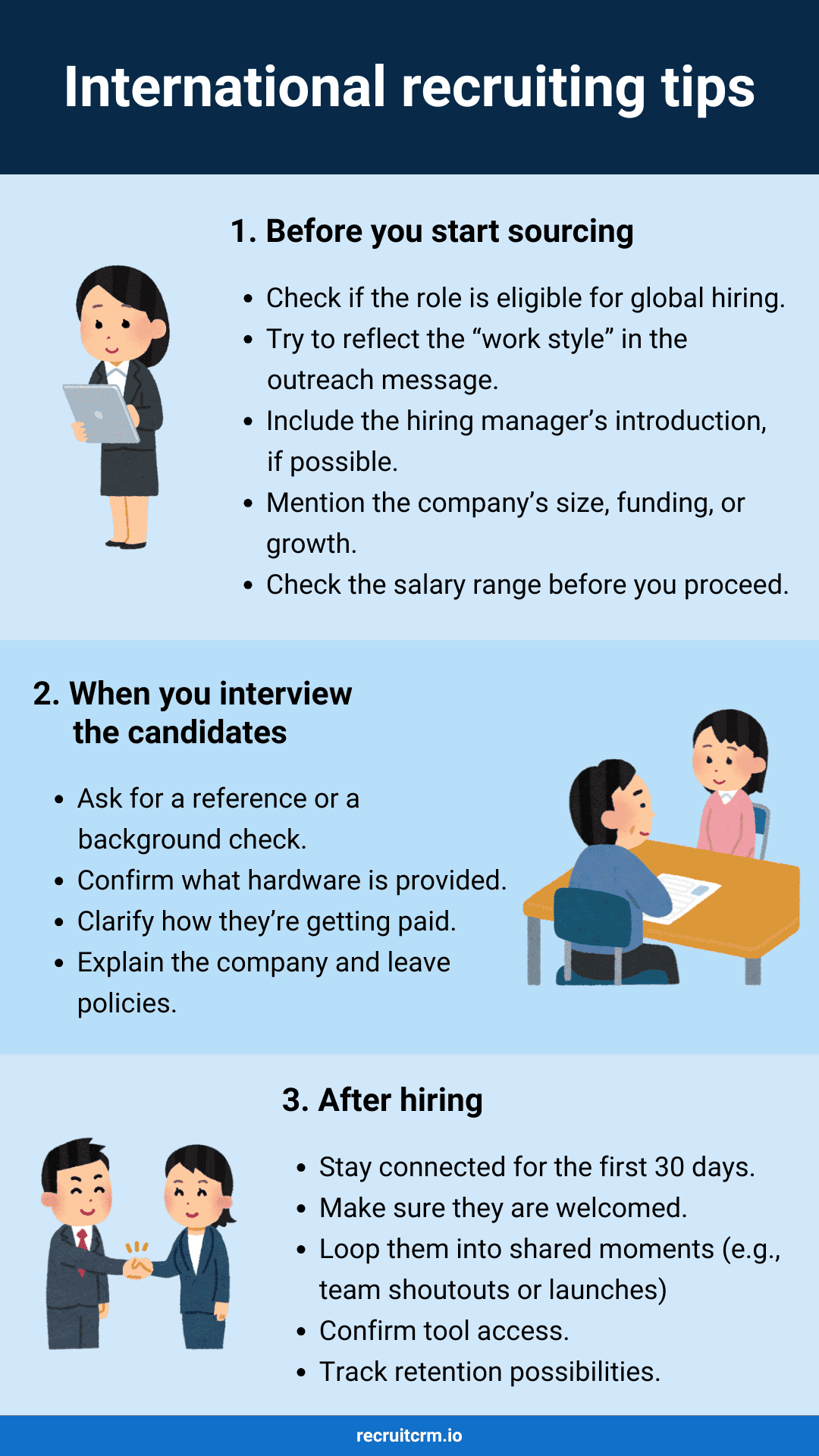
Frequently asked questions
1. What is the best way to keep international hires engaged after onboarding?
Signing the offer surely relieves you, but remember, you're just getting started!Remote hires usually consider casual coffee chats, meetings, or creative activities unimportant.
Handing them off to the managers and thinking they’ll figure it out is your biggest mistake.
To avoid candidate ghosting, work with hiring managers to ensure:
- Their onboarding is region-specific (time zones, language, access to tools, etc.)
- They feel visible and heard (regular check-ins, team syncs, and intro calls)
- Your client’s company reaches them (including them in global shoutouts, celebrating regional holidays, or creating personalized welcome kits for them)
2. How do I handle candidates who promise availability across time zones but never show up?
This is one of the trickiest parts of international hiring.Candidates often ghost or go completely silent during working hours.
To avoid this, clarify expectations by asking them upfront. Ask questions like, “Are you okay with this time zone?” and walk them through weekly syncs, daily catch-ups, or late-evening updates.
If they somehow miss the calls, check in on them. Ask them their reasons.
And long term? Build time zone overlaps into your hiring process. This way, you can avoid any productivity issues.
Blog Summary
8 steps to win at international hiring, the smart wayInternational hiring involves recruiting candidates from around the world to meet your clients’ demands. It involves certain steps, such as sourcing, attracting, and outreach, to effectively hire the talent. This guide takes you through 8 essential steps you should know before diving into international recruiting. You’ll learn how to:- Create a global strategy to hire with ease.
- Understand the risks and rules.
- Customize job descriptions, sourcing, and outreach according to the region.
- Gain expertise in identifying if the candidate is the right fit for international hiring.
- Close the deals with proper compliance regulations.
Also, it has a downloadable compliance checklist to help you avoid any further mistakes and attract top talent worldwide.


Get 20% commission on cash collected per month from every customer you refer for upto one year.
Join Recruit CRM’s affiliate program and start making money.
Blog written by
Chhavi Chugh
Manager, Content at Recruit CRM
Chhavi Chugh is a content strategist at Recruit CRM with expertise in creating research-backed content for recruiters. She develops practical, actionable insights that help recruitment professionals streamline processes, improve outreach, and grow their businesses. Chhavi's work is designed to address the specific challenges recruiters face in today's hiring landscape.
Categories
Stay ahead with the smartest
recruitment newsletter out there!
Join 30K+ recruiters reading the best newsletter in recruitment.




 marketing@recruitcrm.io
%201.4700f78c.svg&w=32&q=75) Workforce Cloud Tech, Inc. 28 Mohawk Avenue, Norwood, NJ 07648.
Workforce Cloud Tech, Inc. 28 Mohawk Avenue, Norwood, NJ 07648.


