


ATS for candidate selection: 6 ways to find better hires
An Applicant Tracking System (ATS) improves candidate selection by automating tasks like resume parsing and screening, ensuring that only the most qualified candidates are considered. It standardizes evaluations, reduces bias, and helps recruiters quickly identify the best-fit candidates.Check your calendar and be honest: how much time did you spend manually sorting through resumes and trying to remember which candidate had which skill set last week?
Quite a bit, right? There’s a good chance that a small mistake slipped through the cracks along the way.
That’s why we recommend using an applicant tracking system. It helps streamline candidate selection and automates repetitive tasks.
Want to know how it works? Keep on reading!
Why does your candidate selection process need a structured approach?
1. Inconsistent candidate evaluations
When multiple team members are involved in the candidate assessment process, each with their own set of priorities, evaluations can quickly become inconsistent.One recruiter may focus on technical skills, while another might prioritize cultural fit. This leads to confusion and makes it difficult to make informed, objective decisions.
A lack of consistency also creates a challenge when providing feedback to candidates, as differing evaluations can lead to unclear communication and missed opportunities for constructive criticism.
2. Lost or duplicate candidate profiles
When hiring data is managed manually, important information can easily get lost or misplaced. Resumes might end up in the wrong folder, or candidates could be inadvertently overlooked due to disorganization.Worse yet, some individuals may end up in multiple folders, leading to confusion about who has been contacted and who hasn’t. This leads to wasted time and effort and, in some cases, to missing out on top talent.
An organized system reduces this risk while also ensuring that all applicant interactions are logged and tracked for future reference.
3. Bias and subjective decision-making
Even if you have the best intentions in mind, unconscious bias can sneak into the hiring process.Relying on intuition or gut feelings about a candidate based on their background, name, or even appearance can skew the evaluation process.
This opens the door to discriminatory practices and reduces the diversity of your hiring pool.
Without structure, subjective decision-making can easily creep in, leaving room for bias to negatively impact the recruitment process.
Additionally, this can impact the team's and the company's overall culture, as diverse perspectives and experiences may be overlooked in favor of more similar ones.
A structured approach ensures decisions are based on skills, qualifications, and experience rather than personal biases.
4. Slow resume filtering and manual comparisons
Manually reviewing resumes and comparing candidates against job descriptions can be time-consuming and inefficient.Even the most experienced recruiters can miss key qualifications or overlook strong candidates when they are overwhelmed with applications.
Automated systems that filter and rank candidates based on preset criteria can save you time and help you quickly identify the most qualified individuals. Beyond speeding up the process, automation helps ensure that each candidate has a fair and equal opportunity.
How an ATS improves the candidate selection process
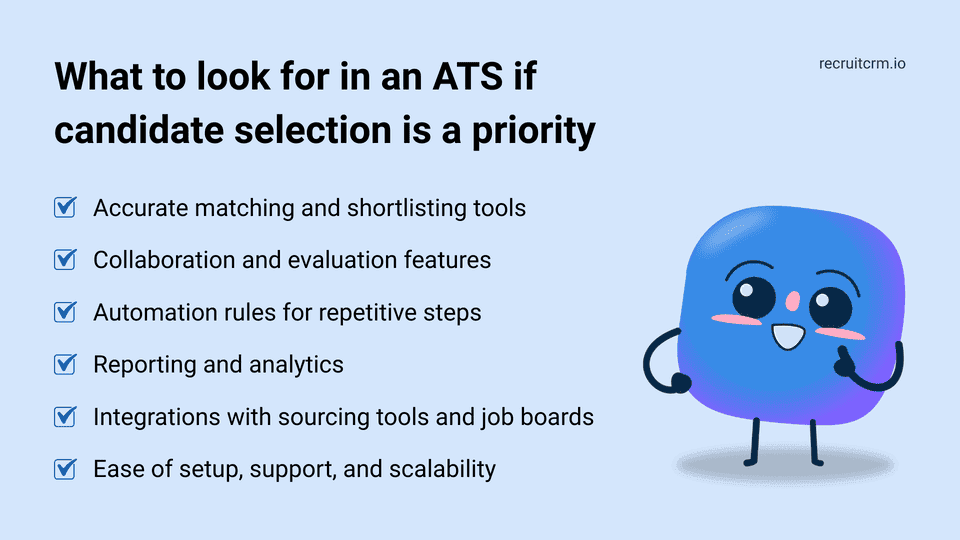
1. Parses resumes and creates searchable candidate profiles
An ATS automatically extracts key information from resumes such as skills, qualifications, work experience, and contact details, making it easy to build a detailed, searchable profile for each candidate.Once the data is parsed, you can quickly search for candidates based on specific keywords, such as skills or past job titles.
Just like that, you have identified top candidates in just a few clicks without missing crucial details.
2. Automates screening to match job criteria
Screening for specific qualifications or experience manually can be time-consuming. An ATS speeds up this task by automatically screening candidates based on pre-set criteria, such as required skills, education, or years of experience.This feature ensures that only the candidates who meet the job’s requirements are flagged for review.
As a result, you get a much more focused shortlist of candidates, making it easier to find the right fit for the role.
3. Scores candidates and analyze their fit
With an ATS, candidate scoring is based on how closely their qualifications match the job requirements. This system allows you to rank candidates objectively, rather than relying on intuition or subjective judgment.In addition to scoring, the software provides a match analysis that breaks down how well a candidate aligns with the role. This can include factors like skills, experience, and cultural fit.
If the candidate is a good fit, the chances of them leaving soon are low, reducing turnover rates.(opens in a new tab)
4. Standardizes interview templates and scorecards
One of the challenges in recruitment is maintaining consistency in how candidates are evaluated. An ATS solves this by offering standardized interview templates and scorecards that ensure every candidate is evaluated on the same criteria.These templates guide interviewers through the questions they should ask, ensuring that key aspects such as skills, experience, and cultural fit are covered every time.
With interview scorecards, interviewers can rate candidates on a consistent scale, reducing personal bias and making it easier to compare candidates objectively after the interview.
5. Keep all notes and evaluations in one place for seamless collaboration
An applicant tracking system centralizes all interview notes, evaluations, and feedback in one place, ensuring that nothing is lost or overlooked.This centralized system makes it easy for your hiring team to stay aligned, with everyone having access to the same candidate data in real time. You won’t need to search through emails or different documents to gather feedback, as everything is easily accessible.
Hiring teams can quickly review a candidate’s history, interview feedback, and status, ensuring that everyone is on the same page.
The ATS reduces delays with the help of real-time collaboration and makes it easier for team members to share feedback, leave comments, and reach a consensus more efficiently.
6. Leverages historical data and reporting to improve recruitment strategies
An ATS has tons of valuable data that can be used to improve your recruitment strategies. The system tracks every step of the hiring process, from the source of your applicants to the time it takes to fill a role.With this data, you can generate detailed reports that provide insights into the effectiveness of your hiring efforts. For example, you can identify which sourcing channels are attracting the best candidates or which process stages are causing delays.
You can continuously refine your hiring strategy to improve both speed and quality by conducting these recruitment audits.
How does Recruit CRM help in candidate selection?
Now that you've seen how an ATS can transform your candidate selection process, here's how Recruit CRM helps you actually achieve those results.Hire faster, decide smarter: Over 2,000 recruitment agencies across 100+ countries use Recruit CRM to reduce their time-to-hire by up to 22%. That means less time screening, more time placing candidates, and faster revenue generation.
Stop wasting hours on unqualified candidates: Our AI-driven sourcing automatically surfaces the best-fit candidates based on your job requirements. You'll spend your time interviewing top prospects instead of sifting through hundreds of mismatched resumes.
Eliminate manual busywork: Automated resume parsing and candidate matching mean you don't have to copy and paste information or manually score applications. The system does the work, so you focus on closing placements.
Work with the tools you already use: With 5,000+ integration partners through Zapier and Integrately, you can connect Recruit CRM to your existing workflow—whether that's video interview platforms like Jobma, assessment tools like WedgeHR, or any other tools your team depends on.
We have also collaborated with the UK's leading independent job board, CV-Library, to ensure our shared customers can seamlessly use the job board to post vacancies and maintain their candidate database on our recruiting software.
Mistakes recruiters make when using an ATS
| Mistakes | How to avoid them |
| Relying only on automation without reviewing matches | Yes, recruitment automation speeds up the process but should not replace human judgment. Review candidate matches to consider broader qualifications, in-demand skills, and potential fit. Don’t overlook strong candidates who may not fit the typical profile but bring valuable qualities. |
| Writing poor job descriptions | Craft clear, specific, and detailed job descriptions. Avoid vague terms like "excellent communication skills" and use industry-standard keywords. Collaborate with your team to ensure the job description reflects the exact skills, qualifications, and experience required. |
| Not customizing workflows, filters, or scoring | Customize workflows, filters, and candidate scoring to match your company's specific needs. Tailor filters for soft skills, industry experience, or technical certifications. This will provide a more accurate shortlist and align the ATS with your recruitment goals. |
| Giving incomplete training | Invest in comprehensive, ongoing training for your team. Ensure recruiters and hiring managers fully understand all features of the ATS, such as candidate screening, resume parsing, and real-time collaboration. Schedule regular training and encourage questions for continuous improvement. |
Frequently asked questions
1. Do small recruitment teams need an ATS?
Absolutely. Even small recruitment teams can benefit from the efficiency and organization an ATS offers.As your team grows and recruitment volumes increase, using the platform becomes even more essential. It helps automate repetitive tasks like resume parsing, candidate screening, and interview scheduling, and many more.
2. How long does it take to set up an ATS?
The time it takes to set up an ATS depends on several factors, including the complexity of your hiring process, the size of your team, and the level of customization needed. Generally, setting up an ATS can take anywhere from a few days to a couple of weeks.Recruit crm, for that matter, takes 10-12 days to set up, and we’ve had a 100% success rate on 250+ data migrations.
3. Can an ATS integrate with LinkedIn Recruiter or job boards?
Yes, most modern ATS platforms offer integrations with LinkedIn Recruiter, job boards, and other external platforms.These integrations allow recruiters to source candidates directly from these platforms and automatically import candidate profiles into the ATS, saving time and reducing data entry errors.
ATS systems can also sync with your email, calendar, and other tools to ensure a seamless recruitment workflow.
4. Does an ATS improve candidate quality or only speed?
An ATS can improve both the quality and speed of your recruitment process. An ATS helps you quickly identify the best candidates by automating repetitive tasks like resume screening and candidate ranking.For example, Group928, a proud user of Recruit CRM, doubled their executive placements within a year by streamlining these processes.
Additionally, by standardizing the evaluation process, an ATS helps eliminate bias, ensuring that each candidate is assessed by the same criteria and leading to better, more objective hiring decisions.
5. How long does an ATS store candidate data?
The length of time an ATS stores candidate data depends on your company’s policies and data protection regulations.Generally, an ATS stores candidate data for a period of 6 months to 2 years. However, candidates can be flagged for future job opportunities, and the system allows you to manage the data in compliance with GDPR or other local privacy laws.
Blog summary
An Applicant Tracking System (ATS) enhances the candidate selection process by automating key tasks.It begins with resume parsing, organizing candidate profiles for easy search and review. Automated screening filters out unqualified candidates, while candidate scoring and match analysis help prioritize the most suitable applicants.
The ATS streamlines interviews with standardized templates and scorecards, ensuring consistency across evaluations. It stores notes and evaluations in one centralized system, improving collaboration and ensuring no feedback is missed.
Real-time updates allow for efficient decision-making, and historical data provides valuable insights for improving recruitment strategies over time.
To make the most of an ATS, recruiters should avoid relying only on automation without human oversight, write clear and detailed job descriptions, and customize workflows and scoring to fit each role. Proper training is also key to ensuring consistent use of the system across the team.
About The Author:
Joyce Remy is a writer and blogger with a passion for entrepreneurship. Her writing aims to inspire and educate small businesses owners. She often contributes to the Content Clerks blog.


Get 20% commission on cash collected per month from every customer you refer for upto one year.
Join Recruit CRM’s affiliate program and start making money.
Categories
Stay ahead with the smartest
recruitment newsletter out there!
Join 30K+ recruiters reading the best newsletter in recruitment.