


15 FAQs on SEO for recruiters [Clear your doubts!]


In this SEO FAQ for recruiters, we’ve answered 15 of the most commonly asked questions about how search optimization works in recruitment.
Along the way, you’ll find practical examples, step-by-step tips, and tools that make it easier to apply SEO to your agency’s website, career page, and job postings.
Get your queries answered here, or simply scroll to the question you’re looking for.
1. What is SEO in recruitment?
SEO in recruitment means making sure your agency shows up when people search online for recruiters or jobs.It’s about getting your website, career page, and job listings to rank higher on Google so the right clients and candidates can find you.
For example, if someone searches “engineering recruitment agency in Manchester,” SEO is what helps your agency appear on the SERP in the first position.
It involves using the right keywords, structuring your site properly, and giving search engines the information they need.
2. Why should recruitment agencies care about SEO?
Most clients and candidates start their research with a Google search.If your agency doesn’t appear, those opportunities go straight to competitors, and that’s exactly where SEO makes the difference.
Here’s how it helps you:
- Visibility where it matters: You show up when people actively look for recruiters in your niche or location.
- Qualified leads: SEO attracts clients and candidates who are already searching for services like yours, not random traffic.
- Credibility boost: Being on the first page signals trust and professionalism.
3. What are the four types of SEO?
1. On-page SEO
This is where you make every page on your site match exactly what your clients and candidates are searching for.If you just post a role as “Marketing Manager,” you will get buried in results, but if you optimize it with the exact phrase people type into Google, like “Digital Marketing manager jobs in Chicago,” you will show up in front of the right audience.
The same applies to your service pages. Clearly define your niche with relevant keywords.
Do not forget the details that search engines rely on, like writing unique meta descriptions, using clear headings, and adding job schema so your listings qualify for Google Jobs, which can be reviewed with an on page SEO check tool(opens in a new tab). You can also apply AI-driven blog optimization techniques(opens in a new tab) to continuously refine content performance and keyword alignment.
2. Off-page SEO
Think of off-page SEO as your reputation outside your own website.Search engines look at how often other trusted sources mention or link back to you to decide how credible you are. Working with experienced White Label Link Building Agencies(opens in a new tab) can accelerate your backlink strategy(opens in a new tab) and help recruitment agencies build a stronger external reputation.
A feature on an HR publication or a link from a respected recruitment association carries far more weight than dozens of low-quality directories.
Reviews also play a big role here.
When clients or candidates leave detailed feedback that mentions your niche and location, it not only helps you rank higher but also builds trust with anyone researching your agency.
3. Technical SEO
Even with great content, you will struggle to rank if your site is not technically sound.If you have ever posted the same job twice, you may have created duplicate pages that confuse Google and cut down your visibility.
Even slow career pages can also make candidates leave before they apply, costing you placements.
Technical SEO addresses these issues by ensuring your site loads quickly, is easy to navigate, functions smoothly on mobile devices, and operates securely over HTTPS. Engaging professional technical SEO audit services(opens in a new tab) helps uncover deeper architectural bottlenecks that might otherwise remain invisible to standard automated diagnostic scans.
These fixes are not always visible, but they directly affect how well your jobs and services perform in search.
4. Local SEO
Most agencies depend on clients and candidates in specific cities or regions, and local SEO makes the difference(opens in a new tab) there.When someone searches “IT recruitment agency in Manchester” or “healthcare recruiters near me,” you want to be the one that shows up.
To achieve this, you need a well-optimized Google Business Profile(opens in a new tab) with the right category set to “Recruiter.”
Ensure that your business name, address, and phone number are consistent across all online directories.
Creating location-specific landing pages for each market you serve also helps.
4. What is the 80/20 rule for SEO?
The 80/20 rule in SEO means that a small share of your actions creates the largest share of your results. It is not about doing everything, but about identifying the few activities that deliver the most impact.For a recruitment agency, that usually comes down to the essentials.
A handful of well-optimized pages that target your main sectors, a strong Google Business Profile, and quality links from a SaaS link building agency(opens in a new tab) can generate most of your leads.
Smaller tasks like tweaking fonts or chasing dozens of weak backlinks rarely make a meaningful difference.
The value of the 80/20 rule is in focus. When you know which actions consistently bring candidates and clients, you can put your time and resources into those, instead of spreading yourself too thin across low-value tasks.
5. What are the 3 C’s of SEO?
The 3 C’s of SEO stand for content, code, and credibility.Each one plays a crucial role in how well your recruitment agency presents itself online.
Content is what search engines and people come for.
If your job ads, service pages, and blogs answer the exact questions candidates and clients are asking, you will earn more visibility.
Clear job titles, sector-specific landing pages, and helpful articles on hiring trends all signal relevance to Google while giving your audience real value.
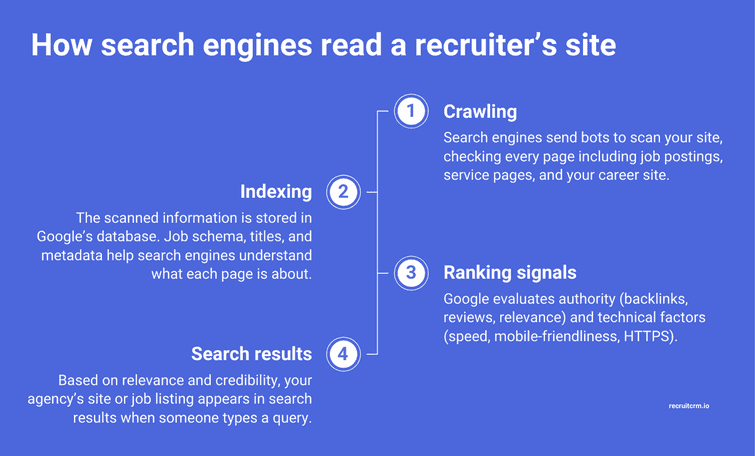
Code is the technical side of your website. Search engines need to be able to crawl and understand your pages.
Clean site structure, fast loading speeds, mobile optimization, and secure HTTPS all make a big difference.
If your site is slow or cluttered, candidates may leave before applying, and search engines may rank you lower.
Credibility shows how much others trust you. Google looks at signals like backlinks from reputable sites, client and candidate reviews, and brand mentions.
When other credible sources point to your agency, it tells search engines that you are reliable and worth ranking higher.
6. How is SEO different from running paid ads for recruitment?
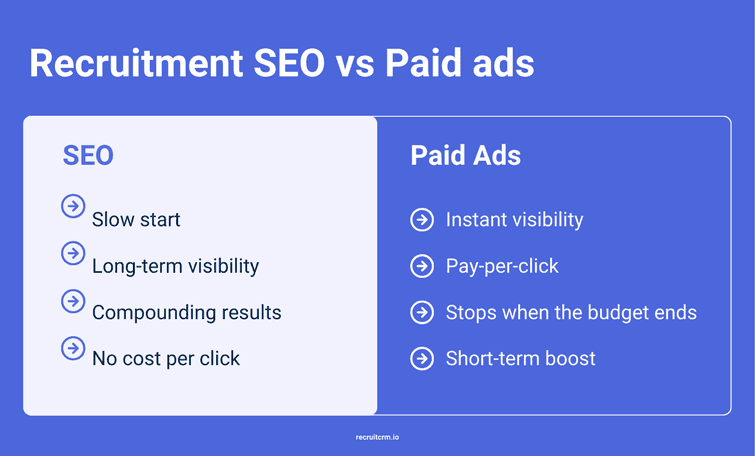
With paid ads, you pay for every click or impression.
If you want to promote a “Sales Manager job in London,” you set up a campaign, bid on the keyword, and your listing shows up immediately.
The catch is that once the budget is spent, the listing disappears, and you are back to square one.
SEO works differently.
When you optimize that same role on your website with the right keywords, structure, and schema, it can start ranking in search results without ongoing spend.
It takes more time to build momentum, but once in place, the role can continue to attract candidates long after the ad campaign has ended.
For client acquisition, the difference is even sharper.
Ads can put your agency in front of decision-makers quickly, outsource SEO(opens in a new tab) builds long-term authority and trust online today.
When a company keeps seeing your site in search results, it builds familiarity and trust that ads alone rarely deliver.
7. How long does it usually take for recruiters to see results from SEO?
SEO does not deliver overnight wins.Search engines need time to crawl your site, evaluate changes, and test how users respond.
For most recruitment agencies, results start to show within three to six months, though the timeline can vary.
What influences the speed:
- Website history: New sites usually take longer to gain traction, while established domains with some authority may see results sooner.
- Competition: Agencies in crowded sectors like IT or finance often need more time than those working in niche industries or local markets.
- Type of SEO work: Quick technical fixes, such as improving site speed, can show small gains in weeks. Content strategies and backlink building(opens in a new tab) take longer but deliver stronger, lasting results.
- Geography: Local SEO(opens in a new tab) for a specific city or region often moves faster because you are competing with fewer agencies.
8. Should I optimize my agency website, my career page, or individual job postings first?
Your starting point should be the agency's website, as it sets the foundation for everything else.When clients or candidates search and land on your site, the homepage and service pages are what convince them to stay.
If these pages are not clear or optimized, even a polished career page or job listing will struggle to perform.
A strong website structure, sector-specific content, and well-written service pages give search engines a base to work with and help the rest of your site rank better.
A career page that loads quickly, works seamlessly on mobile, and organizes jobs by category or location improves both user experience and search visibility.
Adding sector and city-specific details here makes it easier to show up for searches like “finance jobs in Dublin” or “IT jobs in Manchester.”
With the website and career page in place, you can then focus on individual job postings. These benefit from the authority of the overall site and are more likely to rank well once the structure around them is strong.
To keep it simple:
- Build authority and trust with a strong agency website first.
- Convert candidates with a clean and optimized career page.
- Expand reach with job postings that are keyword-friendly and structured for search engines.
9. Does creating blogs or content really make a difference for recruiters?
Yes, but only when you create content with a clear plan. It needs to be built around what clients and candidates are searching for.Here is how you can approach it:
- Identify your audience’s questions - Candidates search for terms like “how to write a CV for IT jobs” or “best companies hiring sales managers in London.”
Use these questions to create your topics.
- Match each topic to a goal - A blog on interview tips can attract candidates.
- Choose the right format - Not every subject needs a long blog.
- Optimize the basics - Use clear titles with the keywords your audience types into search.
- Stay consistent - A single blog will not change much.
Good content makes you discoverable even when people are not directly searching for a recruitment agency.
It allows clients and candidates to find you while looking for solutions, which then brings them back to your services.
10. Can SEO actually help smaller recruitment agencies compete with bigger firms?
Yes, because search engines value relevance over size.Large firms try to cover multiple industries and regions, which makes it hard for them to dominate every search.
A smaller agency that focuses on one sector or location can become the most relevant result for that area and rank higher than bigger names.
You also have the advantage of speed. Updates to your site, adding new content, or responding to changes in hiring trends can be done quickly without the delays larger firms face.
That flexibility helps you capture traffic faster when demand shifts.
Smaller agencies can also use SEO(opens in a new tab) to highlight their personal approach.
Sharing detailed case studies, client stories, or niche insights gives you unique content that big firms rarely create.
Search engines reward that originality, and it helps clients and candidates see you as a specialist rather than a generalist.
When you play to these strengths, SEO gives you a real chance to win visibility and trust in the areas that matter most to your business.
11. Do I need to hire an SEO expert, or can my team handle it in-house?
You can manage the basics in-house if your team is ready to learn, but partnering with an SEO agency(opens in a new tab) makes a difference when you want to go deeper.They can run full technical audits, build a structured keyword strategy across your service pages, secure high-quality backlinks(opens in a new tab), and track performance with precision.
An expert also brings experience from other industries, which can shorten the trial-and-error phase and help you see results faster.
A smart approach for most agencies is to start in-house with the essentials, then bring in an expert once you want to compete in tougher markets or scale more aggressively.
12. What are the most common SEO mistakes recruitment agencies make?
1. Delete expired job postings without redirects
Many agencies remove job ads once roles are filled.This leaves broken links and weakens site's authority.
The better fix is to set up 301 redirects that send users and search engines to an active job category or a related role, so the traffic is not wasted.
2. Publish duplicate or near-duplicate job ads
Posting multiple versions of the same role, such as “Software Engineer London” and “Software Engineer Central London,” creates duplicate content.Search engines struggle to decide which one to rank, and visibility suffers.
Consolidating into one well-optimized posting works better.
3. Ignore internal linking across the site
Jobs, blogs, and service pages are often published in isolation.Without links connecting them, search engines cannot understand the site structure.
Internal links from job ads to sector pages or from blogs to services strengthen rankings and guide users deeper into your site.
4. Allow the site to bloat with old listings
Recruiters add new jobs constantly, but rarely clean up expired ones.This clutters the site, slows performance, and wastes crawl budget on irrelevant pages.
Regular audits and pruning low-value content keep the site lean and easier for search engines to index.
13. How much budget should a small recruitment agency realistically set aside for SEO?
A small agency can usually start with $500–$1,500 per month.This covers essential tools for keyword tracking and analytics, content creation, like blogs or optimized landing pages, and occasional technical fixes.
If you want faster growth, hiring an SEO consultant or agency typically costs $800–$2,000 per month, depending on competition and workload.
The key is to begin with the basics, measure results, and increase spend as SEO starts driving consistent leads and applications.
14. What are some simple tools or platforms that make SEO easier for recruiters?
1. Google Search Console
Shows which keywords trigger impressions and clicks, highlights indexing issues, and alerts you if Google struggles to read your site.For recruiters, it is the fastest way to check if job postings and service pages are visible in search.
2. Google Analytics 4
Tracks how visitors interact with your site once they land.You can see which pages candidates visit most, how long they stay, and whether enquiries or applications come from organic traffic.
3. Ubersuggest
Provides keyword ideas with search volume and difficulty scores.A useful, budget-friendly tool for finding terms candidates and clients actually type into Google.
4. AnswerThePublic
Maps out common search questions.Great for building blog topics or FAQs that target the exact queries job seekers and employers are asking.
5. Screaming Frog SEO Spider
Crawls your site to find issues like broken links, duplicate titles, or missing metadata.Essential for agencies that publish many job postings and need to keep the site clean.
6. Ahrefs
All-in-one platforms for tracking keyword rankings, monitoring backlinks, and analyzing competitors.Helpful if you want to see where rival agencies rank and uncover gaps you can fill.
7. Whitespark
Focuses on local SEO(opens in a new tab) by managing your business listings across directories.Ensures your agency’s name, address, and phone number stay consistent everywhere, which boosts local rankings.
15. How does SEO help attract more candidates and clients?
SEO helps attract more candidates and clients by improving your website's visibility in search engine results. It targets relevant keywords, bringing in traffic from users actively searching for recruitment services or job opportunities.SEO also enhances user experience through faster load times and mobile optimization, keeping visitors engaged.
High-quality, optimized content builds trust, while local SEO(opens in a new tab) ensures your agency ranks for relevant geographic searches.
Ultimately, SEO drives more relevant traffic, helping you connect with the right people.
Blog summary
This SEO FAQ for recruiters answers 16 key questions designed to help agencies attract more clients and candidates through search optimization.It explains how SEO improves visibility for agency websites, career pages, and job postings so the right people can find you at the right time.
The guide breaks down the four main types of SEO: on-page, off-page, technical, and local, with practical recruiter-focused examples.
It introduces the 80/20 rule to show which activities deliver the biggest results and outlines the 3 C’s of SEO: content, code, and credibility.
The blog also contrasts SEO with paid ads to highlight why SEO offers lasting returns once it is established.
Recruiters learn realistic timelines for results, how to prioritize their efforts, and which mistakes to avoid.
It also provides budget guidance and a list of simple, effective SEO tools built for recruitment agencies.




Blog written by
Kaushal Chandratre
Content writer at Recruit CRM
Kaushal Chandratre is a content writer at Recruit CRM, where he writes content designed to make recruiters’ lives easier. He focuses on simplifying complex hiring processes and sharing practical strategies that recruiters can apply in their day-to-day work.
Stay ahead with the smartest
recruitment newsletter out there!
Join the recruiters who never miss what’s next.









 marketing@recruitcrm.io
%201.4700f78c.svg&w=32&q=75) Workforce Cloud Tech, Inc. 28 Mohawk Avenue, Norwood, NJ 07648.
Workforce Cloud Tech, Inc. 28 Mohawk Avenue, Norwood, NJ 07648.


