


You are missing out on these top recruitment tools


When buying a new phone, even a recruiter like you would choose the latest iPhone over an outdated Android.
Why? Because it’s packed with the latest tech and features that make life easier.
So, why are you still relying on outdated tools for hiring? It’s time to upgrade!
In this blog, we’ll explore the top recruitment tools that are taking the hiring process to the next level.
What are AI-powered recruitment tools?
AI-powered recruitment tools are digital tools that automate and optimize a company's hiring process.They can help you with a wide variety of tasks, ranging from candidate sourcing and screening to onboarding your new employees.
Unlike recruitment software, which is a comprehensive platform, these tools are often task-specific. Companies can use them to target their specific needs, either independently or by integrating them into their systems.
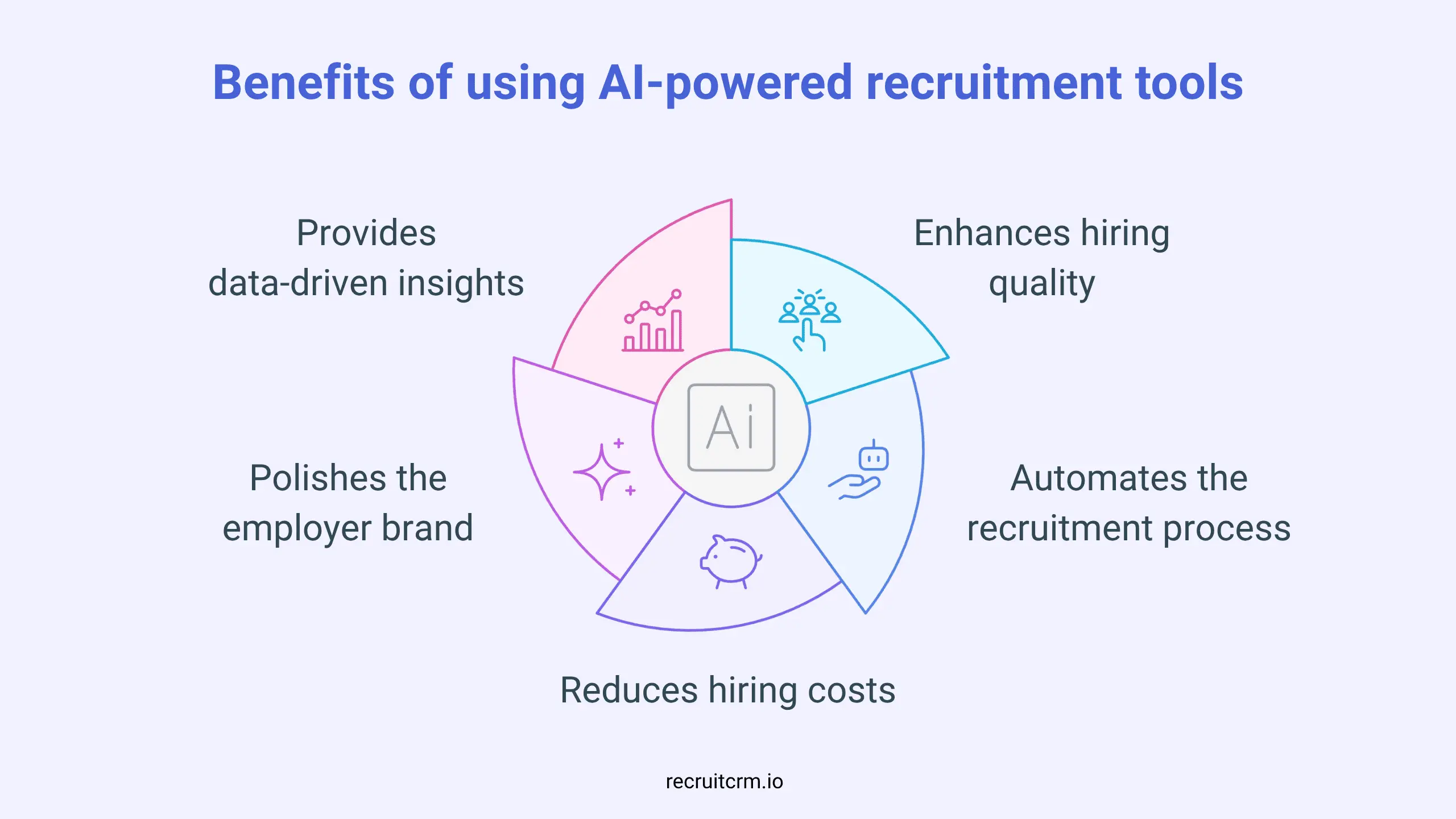
8 types of AI recruitment tools
1. ATS software
According to a Recruit CRM report, almost 93% of recruiters use an applicant tracking system (ATS). It has become the go-to software for many companies as it effectively streamlines the recruitment process.It collects and organizes large volumes of candidate data, making it a centralized platform for candidate management. The recruitment tool also helps you with:
2. CRM software
Candidate relationship management (CRM) software specializes in maintaining long-term relationships with active and passive candidates.Think of it like a marketing tool. It can send personalized follow-up emails, track candidates, and help polish your employer brand by improving candidate engagement. Apart from these core functions, it can also help you with job posting and the production of detailed performance reports using various metrics.
Many companies prefer to use a combined ATS + CRM software, such as Recruit CRM, to harness the best of both platforms simultaneously. While standalone software still exists, its purchase depends on your company's hiring needs and budget.
3. Candidate sourcing tools
When finding new talent feels impossible, candidate sourcing tools are the first choice of recruiters.These are proactive software that use AI and machine learning to go through large volumes of candidate data. Based on your talent-hunt requirements, they can shortlist potential candidates by simultaneously scanning various platforms, such as job boards, social media, and LinkedIn.
Not only do these recruitment tools widen your candidate search, but they also help you with talent pipeline management by improving your candidate engagement.
4. Background check tools
Background check tools are software that help you verify and cross-check the information your candidates provide.The background research is not limited to the demographic information of the candidate. It can also include a review of their criminal records and credit histories to know if you are hiring the right person.
This way, these types of recruitment tools help you maintain your company's value and reputation by keeping it away from legal issues.
5. Interviewing tools
Interviewing tools help you reach diverse candidates without any geographical limitations. They are designed to make the screening process quick and efficient.Apart from serving as a platform for interviews, these recruitment tools can manage your interview schedules and record interview feedback.
AI-powered features provide you with structured interview templates and behavioural analysis of the candidate based on their responses. This makes the interview process fair for all candidates and helps you make data-driven decisions.
6. Recruitment assessment tools
When resumes are not enough for you to assess the skill set of a talent pool, recruitment assessment tools can be a great help.These tools evaluate candidates' skills, abilities, personality, and cognition through various assessment tests. The data gathered from these tests can predict candidate performance and help you make better decisions.
Apart from making better hires, these tools can also reduce unconscious bias in hiring and standardize your company's recruitment process.
7. Employee referral tools
Employee referral tools help you source new candidates by involving your current workforce in the recruitment loop.These tools work on the basic principle of employees referring your company to their friends, family, or colleagues. Self-operating reward systems are used to incentivize employees whenever they bring top talent to you.
This keeps your workforce motivated to work for the company’s success and helps you enhance your brand name(opens in a new tab).
8. Onboarding tools
Once your offer letters are accepted, onboarding tools take over the responsibility of integrating the new candidates into your workforce.These tools overlook tasks such as completing initial paperwork, conducting team introductions, and providing training sessions for the new employees. This promotes personalized candidate experience and ensures smooth transitions into their new roles.
5 must-have recruitment tools for your diverse recruitment needs
1. Recruit CRM
Recruit CRM is an all-in-one applicant tracking system (ATS) and candidate relationship management (CRM) software that streamlines your entire recruitment process.As it combines two types of recruitment tools, it helps you with the basic functions related to candidate management and task automation. Its key features include:
- AI resume parsing: Utilizes AI automation to make candidate profiles based on resume information.
- Candidate sourcing: Provides you with a Chrome extension that helps you source talent from various websites and an AI sourcing tool that brings candidate data to you within a few clicks.
- Candidate communication: Sends mass emails, provides various mail templates, and maintains communication history with the candidates.
- Linkedin integration: Helps you manage your Linkedin conversations within the CRM.
- Data analysis and detailed reports: Uses recruitment analytics tools to get detailed data on recruitment performance.
This data speaks to the global impact Recruit CRM has had in the past few years.
2. LinkedIn (opens in a new tab)
LinkedIn can be your ultimate social media recruitment tool as it is a goldmine for sourcing new candidates. It supports one of the biggest networks of global talent.You can benefit from this employment-oriented social media platform by scanning various candidate profiles, engaging passive talent, and assessing job posting trends.
LinkedIn Recruiter uses AI-assisted features to help you source candidates from the platform, while LinkedIn Jobs allows you to create various job openings.
You can even enhance your employer brand by creating your company's LinkedIn profile and directly engaging with the talent pool through personalized content, employee branding, and messaging features.
3. HireVue (opens in a new tab)
HireVue is a video interviewing platform that allows recruiters to conduct interviews remotely. This reduces the hassle of managing walk-in interviews.It upgrades your interview process by giving you AI-powered assessment features to study and analyze candidates. Based on the interview transcript, you can evaluate their voice tone, communication skills, and speech patterns to get an idea if they would be the perfect fit for the role.
The platform also offers psychometric tests and assessments that help you evaluate candidates' skills. This way, you can verify the listed skills on resumes instead of blindly trusting the talent pool.
4. Erin (opens in a new tab)
Erin is an employee referral software program that helps you find new hires through your active workforce.It handles the referral workflow, allowing employees to submit referrals to the company. You can integrate the platform with an existing ATS to track this candidate data.
Each time an employee brings in a referral, they earn non-monetary micro-rewards, such as points or gift cards. This keeps them highly motivated and increases your employee engagement.
It also enhances your internal recruitment by allowing your employees to apply for open positions. With an increase in referrals and internal talent, the platform significantly reduces the cost-per-hire.
5. Click boarding (opens in a new tab)
Clickboarding automates and personalizes the pre-boarding and onboarding experiences for candidates to avoid employee ghosting.It helps you complete your mandatory tasks such as employee verification, document collection, form completion, and conducting training sessions. It focuses on helping new hires feel comfortable by enhancing candidate engagement through consistent communication.
It unifies the entire workflow by integrating with various systems such as ATS, HRIS, and payroll tools. This makes the entire recruitment process smooth and engaging, resulting in higher retention rates of employees.
Recruitment tools FAQs
1. What recruitment tools offer trial periods?
Many recruitment tools, such as Willo, Gem, and Seekout, offer free trials before you make a purchase. From the recruitment tools mentioned in the blog, only Recruit CRM and LinkedIn offer free trial periods. While LinkedIn Recruiter Lite offers a free trial, Recruit CRM lets you explore its features with a free trial before committing to a paid plan.2. What are the disadvantages of recruitment tools that I need to be aware of?
The following are some downsides of recruitment tools that you must always keep in mind before making any big purchase:- Some recruitment tools are complex and require sufficient time and training.
- Automation can establish personalized communication with candidates, but it sometimes overlooks human details, leading to impersonal interactions.
- Many recruitment tools are expensive for small-scale companies. Before you buy any subscription, make sure that the tool’s ROI is worth the investment.
- Some tools may not be compatible with your existing systems. This can cause workflow disruptions.
3. How to use AI tools for recruitment?
AI tools in recruitment can help you screen resumes, automate candidate outreach using chatbots, and predict candidate success through data analysis. They can also reduce unconscious bias by focusing on skills and experience. This ensures an inclusive hiring process. AI can manage workflow, save time for recruiters and candidates, and help make accurate decisions.4. Can recruitment tools integrate with other softwares?
Yes, most recruitment tools integrate with other software, like job boards, ATS, CRM, and other HR systems. Such integration makes it easy to post jobs, track candidates, and manage communications all in one place. This reduces manual effort and improves hiring efficiency.5. Are recruitment tools secure?
Most of the recruitment tools in the market offer security features like data encryption, role-based access, and GDPR compliance, which make them a secure platform. However, as a purchaser, it is your duty to get a background check on the recruitment tool before you implement it in your hiring process.Summary
This blog helps readers understand the basic definition of AI-powered recruitment tools. It introduces them to 8 types of AI recruitment tools and provides a brief overview of their basic functions. It provides readers with five different recruitment tools for different hiring needs. Towards the end, frequently asked questions about recruitment tools are answered.


Blog written by
Kanan Parmar
Content Manager at Recruit CRM
Kanan Parmar is a content manager at Recruit CRM, specializing in delivering research-driven content that empowers recruiters. Her work focuses on providing valuable insights and strategies that help recruitment professionals optimize their workflows, make informed decisions, and stay ahead in the recruitment industry.
Stay ahead with the smartest
recruitment newsletter out there!
Join the recruiters who never miss what’s next.








 marketing@recruitcrm.io
%201.4700f78c.svg&w=32&q=75) Workforce Cloud Tech, Inc. 28 Mohawk Avenue, Norwood, NJ 07648.
Workforce Cloud Tech, Inc. 28 Mohawk Avenue, Norwood, NJ 07648.


