


How to assess candidates like a pro: 10 proven tips
To make better hiring decisions, assess candidates for skills, fit, and potential. Beyond traditional methods, using structured interviews and skills tests ensures a more accurate evaluation of their suitability for the role.
You can't judge a book by its cover.
And you still fall for a perfect resume and how confidently they answer the question, "Tell me about yourself?"
Stop messing with your hiring decisions right away by evaluating the candidates on the tips that work smoothly.
This blog breaks down 10 power-packed candidate assessment tips that will help you hire with confidence. It also reveals the benefits of candidate assessment and addresses some common questions that may resolve your doubts.
What is candidate assessment?
Candidate assessment is the systematic process of evaluating applicants based on how they match the job requirements, skills, experience, and cultural fit.This effective evaluation method determines the applicants’ performance and behavior, reducing the risks of making bad hires that could cost you money, time, and your reputation.
Simply put, candidate assessment adds a layer of trust to help you decide the next steps in your hiring process.
10 pro candidate assessment tips every recruiter needs!
Tip 1: Define key skills and traits for the job role clearly
If you are expecting your candidate to be the perfect fit, start by clearly defining what you expect from them.Vague terms like "culture fit," "fast learner," or "thoughtful" don’t provide much understanding of your expectations.
Your job descriptions should state exactly what you need.
Start by asking your hiring manager relevant questions like:
- How do you expect them to show up during daily tasks?
- What outcomes do you expect in the first 30 days?
- What does success look like for this role?
- What skills are required in this type of role?
Let's say you are writing a job description for this.
"We're looking for a software engineer who leads the team step-by-step. You should be comfortable with writing clean, reviewing peer requests, and working under pressure. The way to crack this role is delivering results in time, communicating with product and design teams, and spotting mistakes early to avoid issues down the line."
Tip 2: Test candidates with different types of assessments
Interviews determine how someone presents. Candidate assessments reveal how someone performs.Don't rely completely on what they say. Instead, test them via various assessments that bring out their skills, thoughts, judgment, mindset, or behavior to the surface.
Types of applicant assessment tests that could help you find the right one:
- Skills assessment tests: Measures the candidate's soft skills and hard skills.Example, soft skills: Presenting a scenario to assess critical thinking/ problem solving, etc.Hard skills: Typing tests, writing tests, design tests, etc.
- Cognitive ability tests: Involves understanding the candidate's thinking. Types of tests include verbal reasoning, logical reasoning, abstract reasoning, and others.
- Personality tests: This type of test evaluates candidates’ personality. It may include workplace personality assessments, motivational tests, or the Big Five personality tests.
- Situational judgment tests: This involves evaluating a candidate's decision-making and problem-solving abilities.
- Work samples and simulations: These are practical exercises used to evaluate a candidate's performance. Examples include presentations, technical assessments, and role-playing exercises.
Tip 3: Observe problem-solving behavior in real time
Everyone is a great problem-solver until they are tested with one!Instead of asking boring questions like, "tell me how you solved a problem", challenge candidates with a situation and see how they perform.
You can easily understand how they perform, think under pressure, organize their thoughts, or how they approach it.
This is where you can get your answer by observing their curiosity, logic, or flexibility through the process.
Tip 4: Build meaningful relationships with the candidates
Whether it's in your personal or professional life, relationships shape them.When hiring, you want detailed, honest, and open answers to evaluate the candidates.
The only way? Build a genuine relationship with them by:
- Showing genuine interest beyond their resumes
- Understanding what they expect
- Starting by making them feel light or reducing their nervousness
- Giving them the opportunity to speak without being interrupted
- Sharing thoughts or incidents that could make them feel confident
By the way, purple squirrels are a recruitment term used to define those candidates who are the perfect fit for your job requirement.They are almost like your dream hire who matches the job description, has the necessary skills, and fits smoothly into the company’s culture.
Tip 5: Set standards and use scorecards
If you assess each applicant differently every time, inconsistency becomes apparent.Set the bar by defining what "good" looks like to you.
Use candidate scorecards to determine the hiring criteria, ensuring they are clear, consistent, fair, and repeatable.
Here's how you can do this:
- Pick 4-6 traits that determine success in this role.
- Clearly state what "excellent", "good", "average," or "poor" looks like
- Create a 1-5 scale with some space for notes or red flags.
- Do not use scorecards only for interviews; use them for culture-fit calls, assessment tasks, or final-decision calls as well.
Tip 6: Balance AI & human judgment altogether for evaluation
AI in recruitment is cool and offers a new way to quickly assess candidates!But you can't rely on them completely, as human judgments play a major role in hiring decisions.
You still need to assess the attitude, tone, alignment, or intent required for the job role.
Now the question remains how to balance both?
It's quite simple: Use AI recruiting software for repetitive tasks like screening, summaries, and resume parsing.
Then, use your judgment to observe how someone communicates under pressure, how they understand the situation, and how they adapt in the midst of the conversation, etc.
Don't over-rely on AI; instead, use it to enhance your decision-making.
Tip 7: Present applicants with real-world challenges and notice how they conquer
Candidates often prepare to answer questions during the interviews.Challenge them with real-world scenarios and observe their responses.
For example, present a scenario associated with pressure, tight deadlines, or ambiguity. You can understand how they take it, adapt to it, or communicate thoroughly.
Observe how they structure their response, how they initiate, how they ask questions, and how they tackle the situation.
This provides you with a clear picture of how someone would perform in this role and whether they are a good fit.
Tip 8: Ensure candidate assessments are EEO compliant
The best way to make better hiring decisions is to ensure that your process is fair and compliant.Candidates remember how they were treated, and even one biased decision could cost you a lot more than you imagine.
EEO compliance acts as a foundation for a credible assessment process.
You can ensure this by:
- Using the same questions, tasks, and criteria for each candidate
- Focusing on evaluating on the basis of skills, behavior, and expectations required for the role
- Ensuring no personal questions are involved
- If you're using third-party assessments, make sure they are trained to be fair, transparent, and bias-free
Tip 9: Show genuine interest in applicants' dreams
Every candidate has a goal. Some want growth. Some want to learn. Or some work to earn money.Understanding these is the only way to find the right fit for the job role.
All you need to do is show interest in what they desire, and you will get your answers.
Ask questions like:
- Where do you see yourself in 10 years?
- What have you always dreamed of?
- What kind of work do you find most exciting?
- What do you expect from this role to contribute to you?
Tip 10: Include feedback in each round
Keeping the candidates guessing about what went wrong?This could give you a tag "bad candidate experience" and may question your credibility!
Every candidate deserves to know what has happened during the process.
Include feedback in each round. You are not only giving them a chance to improve, but also enhancing their experience and giving them a reason to respect your evaluation process.
Even if the candidate does not make it through, don't end it with an email rejection.
Instead, try to make it polite by stating what went wrong, how to improve, and make them feel light by asking them to apply later.
Ask these bonus questions to assess your candidates much better
Well, the tips are done! But let’s add an extra step before you make a decision.Include these questions to know candidates better:1. If you could improve anything about your last role, what would it be and why?2. What does success look like to you?3. What type of work tires you and what instantly recharges you?4. How do you manage your day? Explain it to me with a proper timeline.5. When was the last time you made a mistake? And how did you handle it?6. Can you tell me your biggest achievement and how it contributed to the organization?7. How do you take feedback that you do not agree with? Explain in detail.8. How do you approach work when there is no one to guide you?9. What is that one assumption that people make about you often that isn’t true?10. What motivates you to do better at your workplace?
Frequently asked questions
1. How do I reduce bias in candidate evaluations?
Somewhere in the middle of candidate assessments, bias always shows up!You need to avoid this completely.
Start by:
- Defining what role-specific traits
- Including systematic interviews and consistent scorecards to compare on a fair basis
- Structuring feedback with proper documentation and evidence
- Involving various interviewers with different perspectives
- Training your team on analyzing bias traps
- Reducing dependency on resumes to avoid assumptions
2. How can I make assessments more candidate-friendly?
You can make the assessments candidate-friendly by empathising with them.It may sound off, but if your assessments feel confusing and time-consuming, you need to think again.
Make them candidate-friendly by:
- Keeping them relevant to the role
- Setting expectations clearly
- Respecting the candidate's time
- Provide feedback
- Avoid making candidates feel overburdened
3. How do I make candidate assessments inclusive?
Inclusivity begins where fairness prevails and ends where bias prevails.What to do to make candidate assessments inclusive:
- Include types of assessments, ranging from written tests to verbal ones.
- Avoid harsh language and accessibility constraints
- Adapt individual preferences
- Include a structured way to evaluate
4. How do I assess emotional intelligence through candidate assessments?
Emotional Intelligence encompasses being self-aware, adaptable, empathetic, and courageous.You can start by asking, "What was the last feedback you got and how did you take it?" or "How do you take criticisms and how do you ensure it doesn't feel personal?"
After this, observe how they respond and evaluate their ability to initiate and manage the process itself.
Blog Summary
This blog includes 12 solid candidate assessment tips to improve the evaluation process. It emphasizes fair and bias-free candidate assessment that every recruiter should consider.It includes:- A thorough explanation of what candidate assessment is
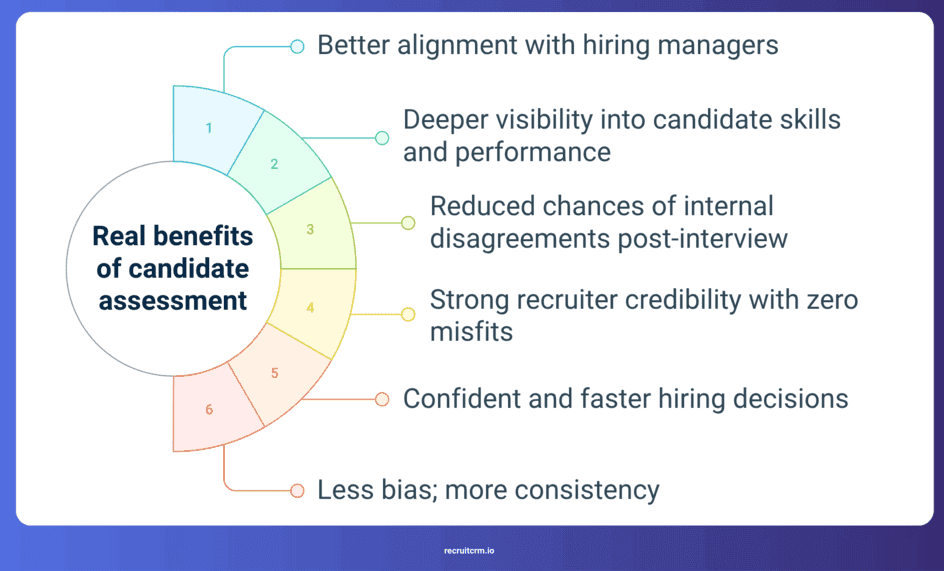
- Benefits of candidate assessment
- 12 tips to improve it
- And commonly asked questions to clear your doubts


Get 20% commission on cash collected per month from every customer you refer for upto one year.
Join Recruit CRM’s affiliate program and start making money.
Blog written by
Chhavi Chugh
Manager, Content at Recruit CRM
Chhavi Chugh is a content strategist at Recruit CRM with expertise in creating research-backed content for recruiters. She develops practical, actionable insights that help recruitment professionals streamline processes, improve outreach, and grow their businesses. Chhavi's work is designed to address the specific challenges recruiters face in today's hiring landscape.
Categories
Stay ahead with the smartest
recruitment newsletter out there!
Join 30K+ recruiters reading the best newsletter in recruitment.