

What is e-learning in recruitment? 6 best platforms


E-learning uses online courses, tools, and practice modules to train recruiters, assess candidates, and onboard new hires. E-learning platforms offer more accessibility, scalability, and consistent tracking than in-person training, letting recruiters learn at their own pace while managers monitor progress.
E-learning, done right, builds your foundation with flexible, scalable, and practical training.
To save you from endless searching, we’ve shortlisted the best e-learning platforms and strategies so you can focus on learning, not filtering through resources.
What is e-learning in recruitment? [+ Advantages]
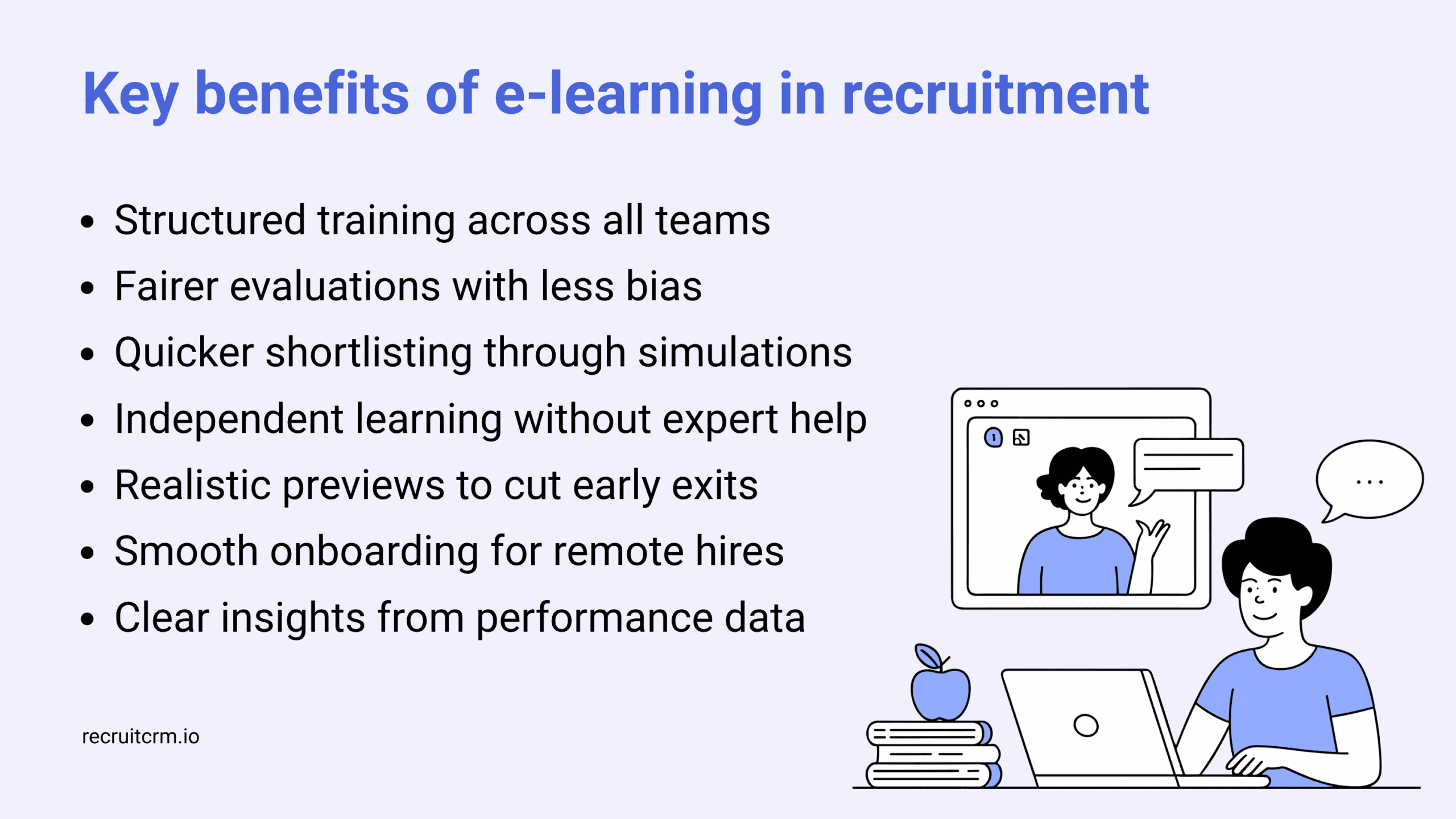
Training and onboarding relied on face-to-face sessions or heavy manuals in the past.But now things have changed, e-learning offers a faster, more consistent, and trackable way to train recruiters and support candidates. It saves time, reduces mistakes, and creates a smoother hiring experience.
E-learning in recruitment refers to the use of online courses, tools, and practice modules to streamline various aspects of the hiring process.
Here’s how it fits in:
- Training recruiters: Short lessons that teach interviewing skills, reduce bias, and explain job requirements.
- Interviewing candidates: Practical tests and simulations that reveal real abilities beyond resumes.
- Onboarding new hires: Quick modules that cover culture, policies, and tasks to help employees settle in faster.
E-learning vs in-person learning in recruitment
Recruitment training can occur today either digitally or face-to-face.This quick comparison aims to help you understand which approach works best for modern recruitment needs and what would best suit you.
| Factor | E-learning in recruitment | In-person learning in recruitment |
| Accessibility | Recruiters can access training at any time, from anywhere, making it ideal for remote and global teams. | Requires physical presence, making it more challenging to scale across multiple locations. |
| Cost-effectiveness | More affordable as it cuts travel, venue, and instructor costs; scalable for large teams. | Expensive due to logistics, trainer fees, travel reimbursements, and venue bookings. |
| Scalability | Online modules can be rolled out to thousands of recruiters simultaneously. | Limited to classroom size; scaling requires duplicating sessions multiple times. |
| Flexibility | Self-paced learning allows recruiters to revisit modules as needed. | Fixed schedules mean recruiters must adapt to the session timing, often disrupting work. |
| Consistency | Ensures uniform training delivery across all employees; reduces interviewer bias. | Each trainer may deliver slightly different content, leading to inconsistencies. |
| Tracking & analytics | Platforms offer real-time progress tracking, completion rates, and performance analytics that are linked to recruitment KPIs. | It is difficult to measure effectiveness beyond attendance, as feedback is often subjective. |
| Engagement | Interactive tools, including simulations, gamification, and assessments, help keep recruiters engaged. | Engagement depends on the trainer’s style and group dynamics. |
| Adaptability | Modules can quickly be updated to reflect new hiring practices, technologies, or regulations. | Updating requires retraining trainers and organizing new sessions, which takes time. |
| Learning retention | Microlearning and practice simulations improve retention through repetition. | Knowledge may fade quickly after one-time classroom sessions without reinforcement. |
| Candidate experience impact | Recruiters trained through e-learning deliver faster, more consistent, and fair assessments. | Candidate experience can suffer if recruiter training varies across team members. |
6 best platforms for e-learning in HR & recruitment
1. AIHR (Academy to innovate HR)(opens in a new tab)
AIHR is a digital university for recruiters and HR professionals. It offers structured certificates in everything from talent acquisition to people analytics, making it an excellent choice for those who want to build a solid foundation and grow incrementally.- Why it’s good: Recognized certificates, progress tracking, and a global community where you can learn from others; it’s handy if you want to demonstrate your skills to employers.
- What to take:
- Strategic talent acquisition certificate (covers end-to-end hiring design and employer branding).
- People analytics certificate (learn to use data to improve hiring decisions and measure recruiter performance).
2. LinkedIn learning(opens in a new tab)
If you prefer quick, practical lessons, LinkedIn Learning is perfect.Its vast library of bite-sized videos helps you improve fast without spending weeks on a single course.
It’s also handy for interviewers and hiring managers who need to be trained quickly.
- Why it’s good: Easy-to-digest lessons that you can watch between tasks, plus regular updates to keep content fresh.
- What to take:
- Interviewer 101
- Structured interviewing
- Unconscious bias
- Productivity lessons on candidate outreach and stakeholder management
3. 360 learning(opens in a new tab)
This one is all about collaboration.Instead of just taking in content, recruiters and subject experts can create training together, so what you learn is always practical and up to date.
- Why it’s good: Great for teams that want to share internal best practices, for example, a senior recruiter can record an interview tip and turn it into a module that others can learn from.
- What to take:
- Role calibration academy (video primers, mock interview libraries, resume evaluation drills).
- Manager dashboards to track skill gaps and align learning with team needs.
4. Coursera for business(opens in a new tab)
Coursera is the go-to for in-depth, professional-grade learning. You’ll find everything from data analytics and sourcing strategies to industry-specific hiring knowledge. Pairing these courses with note taking apps (opens in a new tab)can help recruiters organize key insights and easily revisit them when applying new hiring strategies.This is where you go when you want to level up beyond the basics.
- Why it’s good: Huge catalog of courses from top universities and companies, you can earn certificates that add credibility to your profile.
- What to take:
- TA skills matrix (covers sourcing, assessment design, labor market analysis, and compensation benchmarking).
- Analytics boosters (Excel for recruiters, data-driven decision-making, people analytics foundations).
5. TalentLMS (or LearnUpon)(opens in a new tab)
These are lightweight systems that are great for codifying company-specific processes.- Why it’s good: Easy to set up, integrates with ATS tools, and makes sure everyone follows the same steps in hiring.
- What to take:
- Internal SOPs (structured scorecards, candidate feedback cycles, diversity compliance).
- ATS-triggered learning nudges (auto-enrolled training when a new recruiter joins or a new process launches).
6. Josh Bersin (opens in a new tab)Academy
JBA is more advanced and focused on leadership and future skills. It’s designed for those who want to go beyond operational training and start thinking strategically about talent acquisition in a world driven by AI and skills-based hiring.
- Why it’s good: Research-backed programs, a strong practitioner community, and dedicated tracks for AI in HR. Ideal for recruiters seeking to transition into leadership roles.
- What to take:
- AI in HR certificate (practical ways to use AI in sourcing, screening, and decision-making).
- Skills-based organization cohorts (how to move from role-based hiring to skills-first hiring).
Frequently asked questions
1. How to pick the right e-learning platform?
Start by defining your goal: are you training recruiters, assessing candidates, or onboarding new hires? Look for:- Easy-to-use modules with updated content
- Progress tracking and reporting features
- Integration with your ATS or HR tools
2. Should I go for offline learning?
Offline sessions are helpful for team bonding and personal interaction, but they’re hard to scale and repeat.E-learning is more flexible, affordable, and gives recruiters the freedom to learn anytime, anywhere.
It also ensures that new recruiters across locations receive the same level of training, thereby reducing inconsistencies.
This makes it easier to maintain standards as your team grows.
3. Why is e-learning better for recruiters?
It maintains consistent training across teams, reduces hiring bias, and saves time. Recruiters can learn at their own pace, while managers can track progress and quickly fill knowledge gaps.Unlike traditional methods, e-learning allows instant updates to content.
This means recruiters always have access to the latest practices, industry trends, and compliance guidelines.
4. What are the top recruitment courses I should do?
- Beginner level: Structured interviewing, bias awareness, candidate evaluation
- Advanced level: People analytics, sourcing strategies, industry-specific recruitment skills Platforms like LinkedIn Learning, Coursera, or AIHR offer curated tracks designed for recruiters. Selecting the right combination of foundational and advanced courses will enable you to develop long-term expertise.
5. Can e-learning reduce hiring mistakes?
Yes. Standardized modules make evaluations fairer, enabling recruiters to focus on skills and competencies rather than relying on guesswork.This leads to better hiring decisions and stronger hires. With data and simulations built in, recruiters also learn how to handle tricky interview scenarios, improving consistency in decision-making across the team.
6. What recruitment KPIs should be linked to e-learning completion to prove ROI?
- To prove the ROI of e-learning, link module completion to both leading and lagging indicators across the recruitment funnel.
- Key metrics include time-to-shortlist, pass-through rates by stage, offer cycle time, offer-to-accept ratio, and composite quality-of-hire (such as 90-day productivity, hiring manager satisfaction, and early attrition).
- Using cohort comparisons and control groups can help attribute improvements in these KPIs to interviewer certification and recruiter upskilling.
Blog summary
- E-learning is transforming recruitment by providing scalable, consistent training for recruiters and improving candidate experiences.
- It streamlines the hiring process through automated pre-screening, reduces bias with standardized interview training, and enhances onboarding with realistic job previews.
- By integrating with recruitment metrics, e-learning enables teams to track progress and enhance key outcomes, such as time-to-fill and quality of hire.
- Overall, it makes recruitment more efficient, data-driven, and effective.



Blog written by
Vedika Luhariwala
Content strategist at Recruit CRM
Vedika is a content strategist at Recruit CRM, specializing in creating research-driven content for recruiters. She focuses on delivering practical, actionable insights that help recruitment professionals optimize their workflows, enhance candidate engagement, and scale their operations.
Stay ahead with the smartest
recruitment newsletter out there!
Join the recruiters who never miss what’s next.








 marketing@recruitcrm.io
%201.4700f78c.svg&w=32&q=75) Workforce Cloud Tech, Inc. 28 Mohawk Avenue, Norwood, NJ 07648.
Workforce Cloud Tech, Inc. 28 Mohawk Avenue, Norwood, NJ 07648.


