


Winning recruitment marketing strategies to get top talent
You may not sense it, but your ideal candidates are always watching you, even before you post job opportunities.
This makes it essential for you to outshine your competitors by presenting your brand name more effectively.
This blog will help you strategize your recruitment marketing so that your ideal candidates will always choose you.
What is recruitment marketing?
Recruitment marketing involves the use of various techniques tailored to reach, engage, and attract top talent.If you have noticed, a good company doesn’t wait for its customers to walk into stores and make a purchase. Instead, it advertises and markets its product even before people consider buying it.
Similarly, recruiters must attract top talent not only by posting job ads (and hoping candidates will see them), but also by highlighting the unique benefits of their company.
This way, you actively attract candidates to your company even before they consider applying for your job post!
How to build an effective recruitment marketing strategy?
While learning new recruitment marketing strategies is important, understanding how they are built is even more essential.Let’s discuss some fundamentals that are required for a foolproof recruitment marketing strategy.
Step 1: Define your goals and KPIs
Different companies have different goals. Some want to increase the number of qualified applicant, while others want to increase their brand awareness.Understanding your goals is the ideal way to start recruitment marketing.
If you want to convert your vague and seemingly impossible goals into actionable steps, try fitting them under the SMART goals framework (SMART stands for Specific, Measurable, Achievable, Relevant, and Time-bound goals).
Once you set your SMART goals, focus on tracking the progress you make towards achieving them. This can be done by establishing key performance indicators (KPIs), such as click volume, click-through rate (CTR), conversion rates, candidate engagement, and cost-per-hire.
Step 2: Know your candidate personas
Candidate personas are the profiles of the candidates who possess the qualifications, skills, and traits required by your company. These are the people you are trying to attract.Knowing your target population can help you tailor content that resonates with them. By doing so, you will target the right audience, streamline your recruitment process, and enhance the candidate experience.
Step 3: Create compelling job descriptions
If your job description looks like a long list of requirements, you are doing it wrong!A compelling job description engages and attracts candidates by clearly outlining your company culture.
It targets their needs and aspirations by highlighting the benefits of working at your company and how it would aid in their career growth.
Step 4: Enhance employer branding across platforms
Your top candidates are no fools! They will check you out on every platform before engaging with you. Here comes your shining employer brand need.This can be achieved by making sure that your company’s culture, values, and work environment are clearly communicated on your career page, LinkedIn, Instagram, and other relevant channels, or by partnering with premium digital marketing agencies(opens in a new tab) that specialize in employer branding.
You can also enhance your employer branding by making your employee value proposition (EVP) unique, empowering employee advocates, and engaging your company on various review sites.
Now that you know the basics of creating recruitment marketing strategies, let's explore some expert strategies that will elevate your recruitment game.
How to improve recruitment marketing campaigns?
1. Work on website visibility
Did you know that almost 70% candidates use Google for searching job opportunities?This makes it necessary for you to ensure that your company's website remains visible to the target audience.
Here are some ideas that can help improve your website's visibility:
- Focus on SEO (search engine optimization) to stay at the top of the SERP (search engine result page).
- Use relevant long-tail and short-tail keywords with adequate search volumes across your website.
- Post content that is relevant to your candidate personas.
- Make your career page user-friendly and easy to navigate.
- Optimize your job boards to ensure that your job listings are easily discovered.
2. Enhance candidate experience
Candidates' perception about your company, which we refer to as 'candidate experience,' is shaped by your hiring process.It includes how the candidate feels during the initial job search and application, screening processes, and onboarding experience.
A successful recruitment marketing campaign prioritizes a good candidate experience. You can enhance this experience in many ways:
- Provide clear job descriptions that truly reflect the company values and culture.
- Make your application process simple and intuitive with features like one-click apply.
- Use automated technology such as an applicant tracking system (ATS) for resume parsing.
- Nurture relationships with candidates using software like customer relationship management (CRM).
- Use customized emails to keep candidates informed about their progress in the hiring process.
- Promote transparent communication by being open to receiving honest feedback.
3. Utilize social media
Recruitment marketing has undergone a transformation over the last decade. Almost 84%(opens in a new tab) of organizations in the U.S currently use social media for recruiting.You can now engage with potential clients and enhance your employee brand on platforms such as LinkedIn, Instagram, X (formerly Twitter), and Facebook through job postings, employee advocacy content, and collaborations with influential profiles. Many recruiters also use tools like AI ad generators(opens in a new tab) to quickly create engaging recruitment ads and social media creatives for hiring campaigns. Additionally, applying marketing mix modeling(opens in a new tab) (MMM) can help you analyze the impact of each social media channel on candidate engagement, allowing you to optimize your content strategy and budget for maximum recruitment ROI.
As Gen Z candidate personas are on the rise, ensure you engage with them on platforms that they love, such as TikTok and YouTube.
When optimizing your social media profiles, ensure that you clearly display your company's values, culture, official reviews, and testimonials. This helps to attract and engage passive candidates.
4. Use programmatic advertising
Programmatic recruitment ads target specific candidate demographics based on their online behaviors, interests, and browsing history. This improves your candidate experience and personalizes the hiring process for both parties.By placing your ads on the best digital platforms, such as websites, Facebook, YouTube, podcasts, etc, programmatic job advertising software targets candidates that you desire.
This strategy of programmatic recruitment not only benefits the hiring process but also helps you save dollars with a high return on investment (ROI).
CTA: learn more about the leading programmatic job advertising platforms in the U.S!
5. Make your recruitment process mobile-friendly
More than half of the job seekers are using mobile phones to look for job openings.To truly enhance your candidate experience, it's necessary to make your recruitment process mobile-friendly. You can do it in the following ways:
- Ensure that your career website is fully responsive when opened on small screens.
- Provide candidates with easy-to-complete mobile job applications
- Integrate mobile push notifications to notify candidates about new updates
- Offer mobile-friendly communication such as SMS and quick chats for scheduling interviews and sharing updates.
- Attract candidates through visual content such as photos or virtual company tours.
Recruitment marketing strategies FAQs
1. How can recruitment marketing impact an organization?
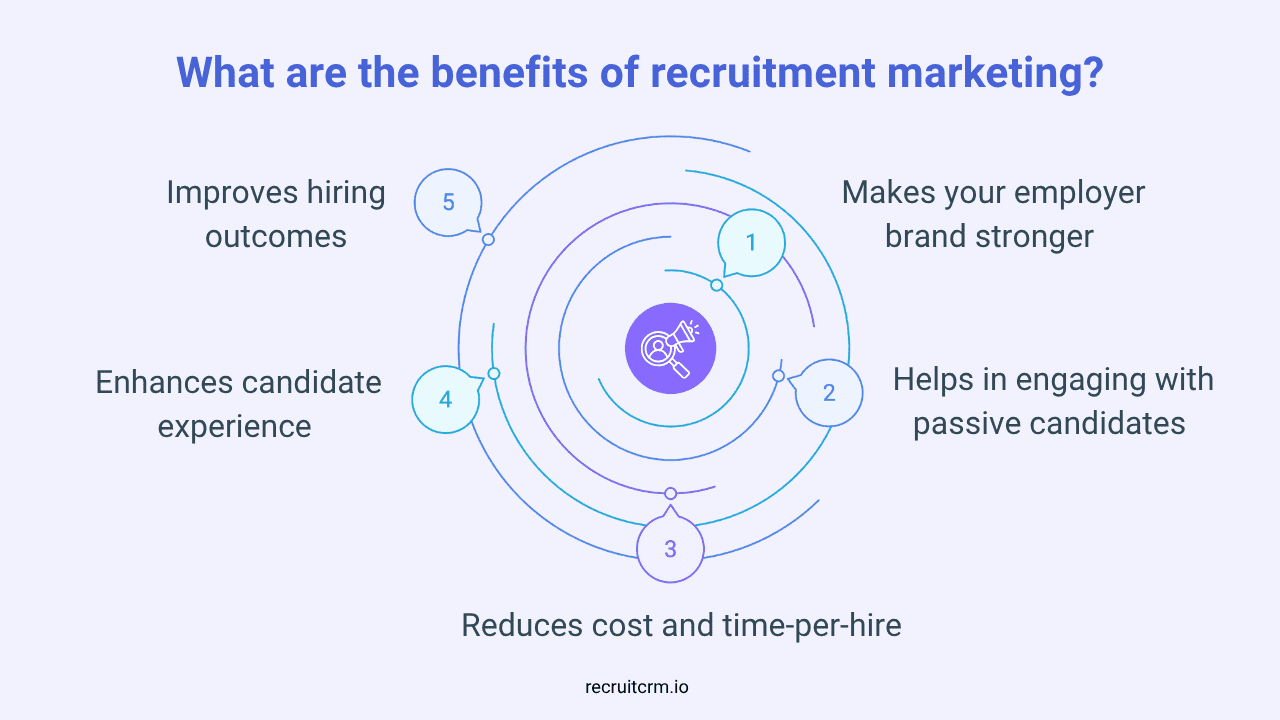
Recruitment marketing is important to attract top talent and improve your employer brand. It helps you fill positions while building long-term relationships with active and passive candidates. Strategizing your recruitment marketing makes you stand out from your competitors, reduces your time-to-hire, and attracts higher-quality applicants. In the long run, it leads to improved retention rates and a more engaged workforce. Simply put, recruitment marketing shapes how the talent pool views your company.2. Which digital channels are most effective for recruitment marketing?
LinkedIn, Instagram, and Facebook are some of the most effective digital channels for recruitment and digital marketing. LinkedIn works wonderfully well for sourcing professional candidates, while Instagram and Facebook help with employer branding and connecting with passive candidates. Job boards and your career website are also essential tools for listing job openings.3. What are the best recruitment marketing tools to use?
There are various types of tools that can help you enhance your recruitment marketing. They are as follows:- Applicant tracking system (ATS) tools
- Candidate relationship management (CRM) tools
- AI and automation software
- Programmatic recruitment software
- Social media management platforms
- Employee referral software
Blog summary
Through this blog, readers gain a basic understanding of what recruitment marketing is and how it can benefit their recruiting process. They learn how an effective marketing strategy is built step by step. This equips them with the basic knowledge that can help them create their own strategies. The blog also discusses five expert tips commonly used in recruitment marketing. Towards the end, general FAQs are provided to address any remaining questions or concerns that readers may have.


Get 20% commission on cash collected per month from every customer you refer for upto one year.
Join Recruit CRM’s affiliate program and start making money.
Categories
Stay ahead with the smartest
recruitment newsletter out there!
Join 30K+ recruiters reading the best newsletter in recruitment.