


9 best AI recruiting software you can’t ignore anymore


AI recruiting software uses machine learning and natural language processing to automate manual tasks. It helps recruiters hire faster, reduce manual work, improve candidate communication, and make more data-driven hiring decisions.
Did you know that your competitor, with half your team size, is placing almost twice as many candidates as you?
The trick is simple. They stopped doing manually what AI can complete in minutes.
Sourcing, screening, and follow-ups take up most of a recruiter's time, leaving them no time for strategic initiatives they are supposed to take. AI recruiting software solves this by automating these tasks, so hours of work get compressed into minutes.
Keep reading to know more about AI recruiting software, its benefits, and your best options right now!
What is AI recruiting software?
AI recruiting software refers to tools that use machine learning, natural language processing, and predictive analytics to assist with tasks across the hiring workflow.These systems can scan thousands of resumes in seconds, identify relevant skills, and highlight candidates who are most likely to move forward in the process.
The category is fairly broad. Some AI tools(opens in a new tab) sit on top of your existing applicant tracking system and act as an automation layer. Others are built as full recruiting platforms that handle sourcing, screening, engagement, and pipeline management in one place.
At its core, the difference is simple. A traditional ATS stores candidate data. AI recruiting software analyzes that data, identifies patterns, and surfaces ranked candidates and recommended actions.
9 key features to look for in AI recruiting software
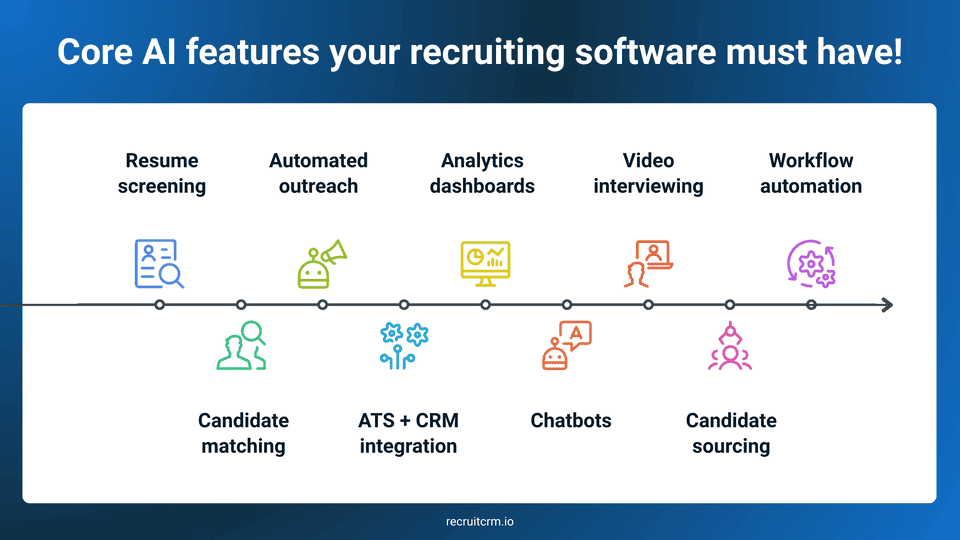
1. AI-powered resume screening
Resume review is one of the biggest hidden time drains in recruiting. Agencies handling multiple roles can easily receive hundreds of applications each month. Even a quick resume scan can turn into hours of manual work before the first interview is scheduled.AI screening tools remove that blocker by reading resumes against job requirements and automatically surfacing the most relevant candidates. Instead of reviewing every profile, you start with a shortlist that already reflects the role criteria.
The stronger platforms look beyond simple keyword matching. They analyze skills in context, career progression, tenure patterns, and other signals that indicate role fit. This improves shortlist quality while significantly reducing candidate screening time.
2. AI candidate matching and scoring
Screening helps remove candidates who clearly do not fit the role. Matching focuses on ranking the remaining candidates.AI matching engines compare candidate profiles against open job requirements and score them based on multiple criteria such as in-demand skills, experience, location, and career progression. The system then ranks candidates by their likelihood of success in the role.
More advanced platforms learn from past hiring outcomes. If certain candidate profiles consistently lead to successful placements, the system adjusts its scoring models to reflect those patterns.
3. Automated outreach and engagement
AI recruiting software can automatically send personalized outreach messages when candidates apply or when recruiters source profiles. Follow-up messages can also be scheduled automatically if candidates do not respond.Strong AI recruiting tools personalize messages using candidate data such as job title, skills, or previous experience. This improves response rates and keeps candidates engaged throughout the hiring process.
If you are managing several searches simultaneously, automated outreach(opens in a new tab) can help you ensure that promising candidates receive timely communication.
4. ATS and CRM integration
AI recruiting software works best when it integrates directly with an ATS and recruiting CRM.Without integration, candidate information becomes fragmented across multiple tools, leading to duplicate records, missed updates, and inconsistent communication.
Integrated AI platforms(opens in a new tab) automatically synchronize candidate profiles, job activity, and communication history. Combining ATS and CRM functionality enables teams to track both candidate pipelines and client relationships in a single place.
5. Analytics and reporting dashboards
Recruiters often have a strong instinct for how their pipeline is performing. Recruitment dashboards turn those instincts into clear, measurable insights.AI recruiting software can track metrics such as time-to-fill, candidate conversion rates across pipeline stages, offer acceptance rates, and recruiter productivity. These insights help teams understand exactly where candidates drop out of the hiring process.
For example, if a large percentage of candidates decline offers or withdraw after the first interview, that pattern becomes immediately visible in the data.
Analytics dashboards also support better client conversations. Showing clients clear reports on sourcing activity or pipeline progress helps build credibility and transparency in the recruitment process.
6. Chatbots
Recruiting chatbots use AI to interact with candidates during the early stages of the hiring process. These AI-driven chatbots(opens in a new tab) help streamline candidate communication by providing instant responses, collecting relevant information, and ensuring a smooth initial screening experience. In AI staffing software, text-to-speech capabilities are integrated into the platform in the chatbots to assist in candidate engagement and communication.These chatbots can greet candidates, answer common questions, collect information such as location or availability, and ask basic screening questions before you get involved.
Because chatbots respond instantly, candidates receive feedback immediately rather than waiting hours or days.
For high-volume roles, chatbots help maintain candidate engagement while filtering out applicants who do not meet basic requirements.
7. Video interviewing tools
Many AI recruiting platforms include video interviewing capabilities to simplify early-stage candidate evaluation.Asynchronous video interviews allow candidates to record answers to predefined questions at a time that works for them. You can review these responses later without scheduling individual calls.
This approach helps you evaluate multiple candidates quickly and identify strong prospects earlier in the hiring process, particularly when summarizing meetings(opens in a new tab) to extract key insights from each response.
Some platforms also analyze video responses using AI to identify communication patterns or relevant keywords, though these signals are typically used alongside human evaluation.
8. AI candidate sourcing across multiple platforms
AI sourcing tools help you find candidates across multiple professional platforms simultaneously.Instead of manually searching LinkedIn, online portfolios, and industry databases, you can define search criteria and let the system automatically gather relevant profiles.
These tools can identify both active and passive candidates who match the role requirements. However, it is essential to address the ethics of generative AI(opens in a new tab) to ensure the hiring process remains unbiased and inclusive.
More advanced platforms enrich candidate profiles with additional signals such as recent activity, career changes, or industry engagement. These insights help you prioritize outreach and focus on candidates more likely to respond. If you also use LinkedIn for candidate outreach, best LinkedIn automation tools(opens in a new tab) can help manage connection requests and follow-ups more efficiently.
9. Workflow automation
Interview reminders, follow-up emails(opens in a new tab), feedback requests, and candidate updates all require coordination between recruiters, candidates, and hiring managers.Workflow automation ensures these actions happen automatically when candidates move between pipeline stages.
For example, the system can send interview invitations, request feedback from hiring managers, or trigger candidate follow-ups without manual intervention.
If you are managing multiple roles and clients simultaneously, workflow automation is the way to keep pipelines moving and reduce the risk of candidates slipping through the cracks.
5 key benefits of using AI recruiting software
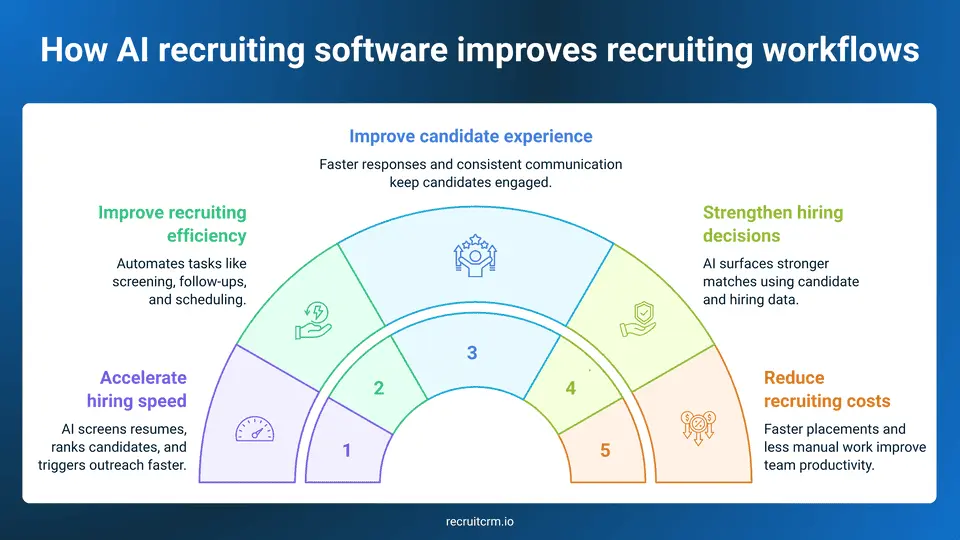
1. Accelerate hiring speed
Recruiting often comes down to who moves first. The candidates you want are usually speaking with several recruiters at once.AI recruiting software speeds up the early stages of hiring. Resumes can be screened within seconds, candidates can be matched to roles instantly, and outreach can go out almost immediately after someone applies.
This means you can begin conversations much earlier, rather than spending hours reviewing applications before contacting candidates. That speed often determines whether a strong candidate stays in your talent pipeline or moves on to another opportunity.
2. Improve recruiting efficiency
A large portion of a recruiter’s day goes into repetitive work. Screening resumes, sending follow-ups, scheduling interviews, and updating candidate records all take time.AI recruiting software handles many of these tasks automatically. Screening happens instantly, follow-ups are triggered automatically, and candidate data updates without manual input.
For example, AI hiring software can automate interview scheduling and eliminate the time-consuming email exchanges necessary to set a mutually convenient schedule. An interview note taker(opens in a new tab) captures and summarizes candidate responses, ensuring critical details never slip through the cracks.
3. Improve candidate experience
Candidate experience has become a major factor in successful hiring.Slow responses, missed follow-ups, and unclear communication often cause candidates to lose interest in a role. In many cases, strong candidates simply move forward with another opportunity where the process feels smoother.
AI recruiting tools help maintain consistent communication throughout the hiring process. Automated responses confirm applications, follow-ups keep conversations active, and scheduling tools reduce delays.
4. Strengthen hiring decisions
In situations where time is limited and information is incomplete, it feels natural to rely on experience and instinct. But those instincts can be wrong too! That’s why you need a data-driven decision-making process.AI recruiting platforms analyze large volumes of candidate and hiring data to identify patterns that might not be immediately obvious. For example, certain experience combinations may consistently lead to successful placements for a specific role type.
These insights help recruiters prioritize stronger candidates earlier in the process. AI can not replace recruiter judgment, but it adds another layer of insight that supports better shortlisting decisions.
5. Reduce recruiting costs
Most recruiting costs come from time.Time spent reviewing resumes that are not a fit, time lost waiting for responses, time wasted restarting searches because the first shortlist missed the mark.
AI recruiting software reduces much of that wasted effort. Candidates are filtered faster, outreach happens earlier, and recruiters spend more time speaking with people who actually match the role.
Over time, this makes the entire hiring process leaner. Roles close faster, recruiters handle more searches, and agencies get more value out of the team they already have.
Top 9 AI recruiting software for recruitment agencies
1. Recruit CRM
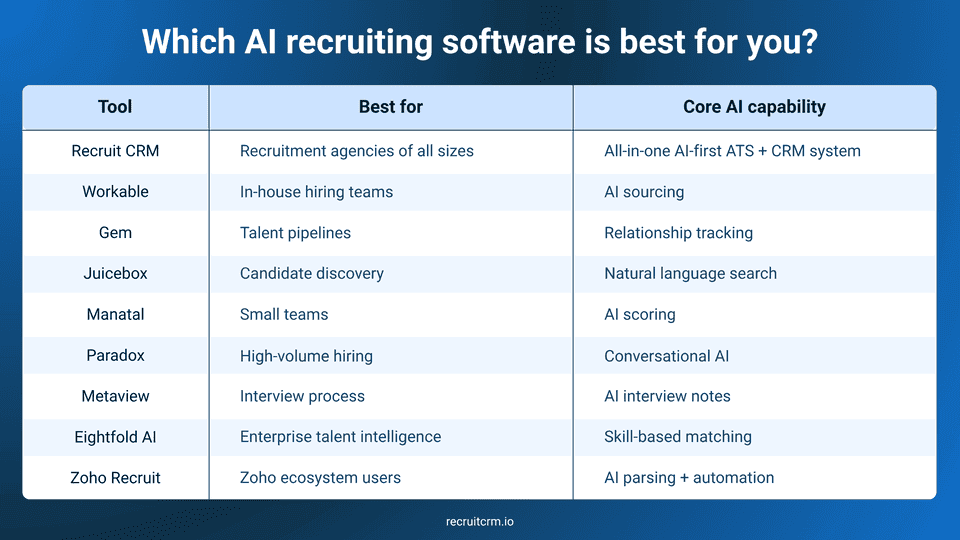
Recruit CRM is designed specifically for staffing and executive search agencies. Unlike many hiring platforms built for corporate HR teams, it focuses on how agency recruiters actually operate.Recruiters can manage candidates, clients, and multiple job orders from a single place while maintaining clear visibility into each search.
What it does well
- Unified ATS + CRM: Candidate pipelines and client relationships live in the same system, giving agencies a single place to manage searches, communication, and placements.
- AI-first recruiting: Built-in AI supports resume parsing, candidate matching, and database rediscovery. GPT-powered tools also help generate outreach emails, job descriptions, and candidate summaries quickly.
- Visual pipelines: A Kanban-style pipeline view shows where every candidate sits in the hiring process, helping recruiters quickly identify bottlenecks or stalled searches.
- Chrome sourcing integration: A Chrome extension allows recruiters to capture candidate profiles directly from LinkedIn and add them to the system instantly.
2. Workable
Workable is a broad hiring platform that supports the entire recruitment lifecycle. It helps teams post jobs, source candidates, evaluate applicants, and manage interview workflows in one system.Its AI-powered sourcing engine scans multiple channels to identify potential candidates, including passive talent who may not have applied directly.
Workable also integrates with a large network of job boards, allowing recruiters to distribute job postings widely without managing each platform individually.
The platform is widely used by in-house recruiting teams, though some agencies also use it when managing a consistent set of clients. Its strength lies in its balanced feature set that covers most recruiting needs without becoming overly complex.
3. Gem
Gem is designed around the idea that strong recruiting pipelines take time to build. Instead of focusing purely on immediate hiring, the platform helps recruiters nurture long-term relationships with candidates.It integrates closely with LinkedIn and tracks every interaction recruiters have with candidates, including emails, messages, and follow-ups.
Over time, this creates a detailed engagement history that helps recruiters understand which candidates are still interested and when they may be ready for a new opportunity.
Gem also provides detailed analytics around sourcing activity. Recruiters can see which outreach strategies are producing responses and which sourcing channels are generating the strongest candidates.
4. Juicebox
Juicebox, also known as PeopleGPT, focuses on improving how recruiters search for candidates. Traditional sourcing often relies on complex Boolean search strings that require practice and experimentation.Juicebox removes that barrier by allowing recruiters to describe their ideal candidate in plain English. The system interprets that description and converts it into a structured search across its candidate database.
Juicebox is primarily designed as a sourcing intelligence tool rather than a complete recruiting platform, so it often works alongside an existing ATS.
5. Manatal
Manatal combines a traditional applicant tracking system with several AI-powered features designed to simplify recruiting workflows.One of its core capabilities is candidate enrichment. The platform automatically gathers publicly available information from professional networks and social profiles to build more detailed candidate records.
Manatal also includes an AI recommendation engine that suggests relevant candidates from the existing database when a new job is created. This helps recruiters reuse past sourcing work instead of beginning each search from scratch.
The platform’s interface is relatively straightforward, making it appealing to smaller recruiting teams or agencies that want useful automation without a complex setup process.
6. Paradox
Paradox focuses heavily on candidate communication through conversational AI.Its virtual assistant, Olivia, interacts with candidates through chat. The assistant can answer questions about the role, ask pre-screening questions, collect candidate information, and automatically schedule interviews.
This model works particularly well for high-volume hiring environments where the main challenge is responding quickly to large numbers of applicants.
Retail, logistics, healthcare, hospitality and automotive AI companies(opens in a new tab) often use Paradox to handle the early stages of the hiring process at scale.
7. Metaview
Metaview focuses on a specific but often overlooked part of recruiting: interview documentation.The platform automatically joins interview calls, records the conversation, and produces structured summaries. These summaries capture key points from the interview and organize them according to the role's evaluation criteria.
This reduces the need for recruiters to take detailed notes during conversations and ensures that feedback remains consistent across the hiring team. Hiring managers also benefit from receiving clear, structured summaries rather than scattered interview notes.
Metaview works best as a complementary tool that integrates with an existing recruiting stack.
8. Eightfold AI
Eightfold AI takes a broader approach to talent intelligence. Instead of focusing only on recruitment workflows, it analyzes skills and capabilities across large talent pools.Its matching engine identifies candidates based on demonstrated skills rather than relying only on job titles or educational credentials. This approach can surface candidates who might otherwise be overlooked by traditional keyword-based searches.
Eightfold also supports workforce planning and internal mobility initiatives, which allow organizations to evaluate both external candidates and existing employees for potential roles.
Because of its scope and complexity, Eightfold is typically used by large enterprises rather than by smaller recruiting teams.
9. Zoho Recruit
Zoho Recruit is part of the broader Zoho software ecosystem and combines applicant tracking with AI-powered recruiting capabilities.The platform includes resume parsing, candidate scoring, and workflow automation designed to streamline common recruiting tasks.
Recruiters can automatically match candidates to relevant roles and trigger communication sequences based on pipeline activity.
One of Zoho Recruit’s strengths is its integration with other Zoho products. Agencies already using Zoho CRM, Zoho Books, or other tools in the ecosystem often find it easier to manage their recruiting operations within the same environment.
How to choose the right AI recruiting software
Before requesting demos, clarify one fundamental point. Are you looking for a system of record or an automation layer?A system of record, usually an applicant tracking system, stores candidate and job data. An automation layer sits on top of that system and performs actions such as outreach, scheduling, scoring, and pipeline movement.
Once that distinction is clear, evaluating modern HRMS solutions(opens in a new tab) becomes much easier.
1. Confirm candidate data ownership
Your candidate database is one of your agency’s most valuable assets. Before committing to a platform, check who owns the data created inside the system.You should always be able to export candidate records and move them elsewhere if needed. If data portability is limited, switching tools later becomes difficult.
2. Check integration with your existing stack
Recruiting rarely happens inside a single tool. Teams usually work with job boards, sourcing extensions, email platforms, and CRMs.AI recruiting software should integrate smoothly with those tools. If recruiters need to copy data manually between systems, the platform will create more work rather than reduce it.
3. Identify your biggest workflow blocker
AI recruiting tools solve different problems. Some specialize in sourcing candidates. Others focus on automation, engagement, or interview analysis.Start by identifying where your workflow slows down the most. If sourcing is the issue, a sourcing-focused platform will help. If administrative work consumes most of the day, workflow automation may provide more value.
4. Consider team adoption
Even the most powerful platform delivers little value if recruiters avoid using it.Tools that require lengthy setup processes or complex workflows often struggle to gain adoption. A simpler system that fits naturally into your team’s daily routine usually performs better.
5. Evaluate tools against your workflow
A practical approach is to map your workflow from job order to placement. Identify the stages that take the most time or generate the most mistakes.Focus your evaluation on tools that improve those specific steps.
Many agencies buy software based on feature lists. In practice, a tool that solves one real bottleneck often delivers more value than a full platform that takes months to configure.
FAQs about AI recruiting software
1. Is AI recruiting software replacing recruiters?
No. AI recruiting software is designed to support recruiters, not replace them. Most platforms automate repetitive tasks such as resume screening, outreach follow-ups, scheduling interviews, and updating candidate records.This allows recruiters to spend more time on relationship building, candidate evaluation, and client communication. Recruiting still relies heavily on human judgment, especially when assessing culture fit, negotiating offers, and advising clients.
AI primarily handles operational tasks that slow recruiters down, enabling them to move faster while maintaining control over hiring decisions.
2. Can AI recruiting software reduce bias in hiring?
AI recruiting software can help reduce certain types of bias when used correctly. Many platforms focus on skills, experience, and role-related criteria rather than personal details during early screening.Some systems also support anonymized screening to remove identifying information, helping recruiters evaluate candidates based on relevant qualifications instead of subjective impressions.
However, AI still requires human oversight because AI algorithms(opens in a new tab) learn from historical data. When used thoughtfully, AI can help create a more structured and consistent evaluation process.
3. How long does it take to implement AI recruiting software?
Implementation time varies depending on the platform type. Tools that plug into an existing Applicant Tracking System can often be set up in a few days.Full recruiting platforms that replace existing systems usually take several weeks to configure, migrate data, and train teams.
The most important factor is how closely the software fits your current workflow. Platforms that align with how recruiters already work typically see faster adoption and quicker results.
4. What types of recruiting teams benefit most from AI recruiting software?
AI recruiting software tends to deliver the most value to teams managing high candidate volumes or multiple open roles simultaneously.Recruitment agencies, staffing firms, and executive search teams often benefit because they handle both candidates and clients simultaneously. In-house recruiting teams also see gains when hiring demand increases or pipelines become difficult to manage manually.
Any team that spends significant time on screening, sourcing, or follow-ups can usually improve productivity with AI-supported recruiting tools.
5. Is there any role of natural language processing (NLP) in AI recruitment software?
NLP, or natural language processing, is a key player in AI recruiting software. It helps the software understand and analyze human language, which means it can parse resumes, interpret job descriptions, and interact with candidates via chatbots, and even incorporate an AI detector(opens in a new tab) to ensure the authenticity of the data being analyzed.This makes resume screening more accurate by extracting relevant information and matching it with job requirements.
Plus, NLP boosts candidate engagement by facilitating meaningful interactions through chatbots, ensuring candidates get timely responses and relevant information throughout the hiring process.
Blog summary
- AI recruiting software helps teams manage high candidate volumes by automating tasks such as resume screening, candidate matching, outreach, and scheduling.
- Typical features include AI resume screening, candidate matching and scoring, automated outreach, ATS and CRM integration, analytics dashboards, recruiting chatbots, video interviewing, AI candidate sourcing, and workflow automation that moves candidates through the pipeline automatically.
- AI recruiting platforms help teams hire faster, reduce repetitive administrative work, maintain consistent candidate communication, support data-driven hiring decisions, and lower recruitment costs by allowing recruiters to focus on qualified candidates and client conversations.
- The blog reviews nine platforms used by recruiting teams and agencies:
- Recruit CRM – Agency-focused ATS and CRM with AI resume parsing, candidate matching, outreach generation, and sourcing integrations.
- Workable – End-to-end hiring platform with AI sourcing, job distribution, and applicant evaluation tools.
- Gem – Relationship-focused recruiting platform for managing long-term talent pipelines and sourcing analytics.
- Juicebox (PeopleGPT) – an AI sourcing tool that converts plain-language candidate descriptions into structured talent searches.
- Manatal – AI-enabled applicant tracking system with candidate enrichment and automated candidate recommendations.
- Paradox – Conversational AI recruiting platform that engages candidates and schedules interviews through a virtual assistant.
- Metaview – an AI interview intelligence tool that records interviews and generates structured summaries.
- Eightfold AI – Talent intelligence platform focused on skills-based candidate matching and workforce insights.
- Zoho Recruit – Applicant tracking system with resume parsing, candidate scoring, workflow automation, and ecosystem integrations.
- Choosing the right AI recruiting software starts with identifying whether you need a system of record (Applicant Tracking System) or an automation layer.
- Teams should then evaluate integrations, candidate data ownership, workflow bottlenecks, and ease of adoption to ensure the tool improves daily recruiting workflows.



Blog written by
Kaushal Chandratre
Content writer at Recruit CRM
Kaushal Chandratre is a content writer at Recruit CRM, where he writes content designed to make recruiters’ lives easier. He focuses on simplifying complex hiring processes and sharing practical strategies that recruiters can apply in their day-to-day work.
Stay ahead with the smartest
recruitment newsletter out there!
Join the recruiters who never miss what’s next.



![How recruiters use Recruit CRM for recruitment [11 ways]](/static-assets/_next/image/?url=https%3A%2F%2Frecruitcrm.io%2Fwp-content%2Fuploads%2F2025%2F07%2FThumbnail-_-https___recruitcrm.io_blogs_recruit-crm-for-recruitment-1.png&w=828&q=75)
![What is recruiting database? [+ Steps to select the best one]](/static-assets/_next/image/?url=https%3A%2F%2Frecruitcrm.io%2Fwp-content%2Fuploads%2F2025%2F05%2FThumbnail-What-is-recruiting-database-Steps-to-choose-the-best-one.png&w=828&q=75)




 marketing@recruitcrm.io
%201.4700f78c.svg&w=32&q=75) Workforce Cloud Tech, Inc. 28 Mohawk Avenue, Norwood, NJ 07648.
Workforce Cloud Tech, Inc. 28 Mohawk Avenue, Norwood, NJ 07648.


