Top 6 Recruiterflow alternatives for recruitment firms


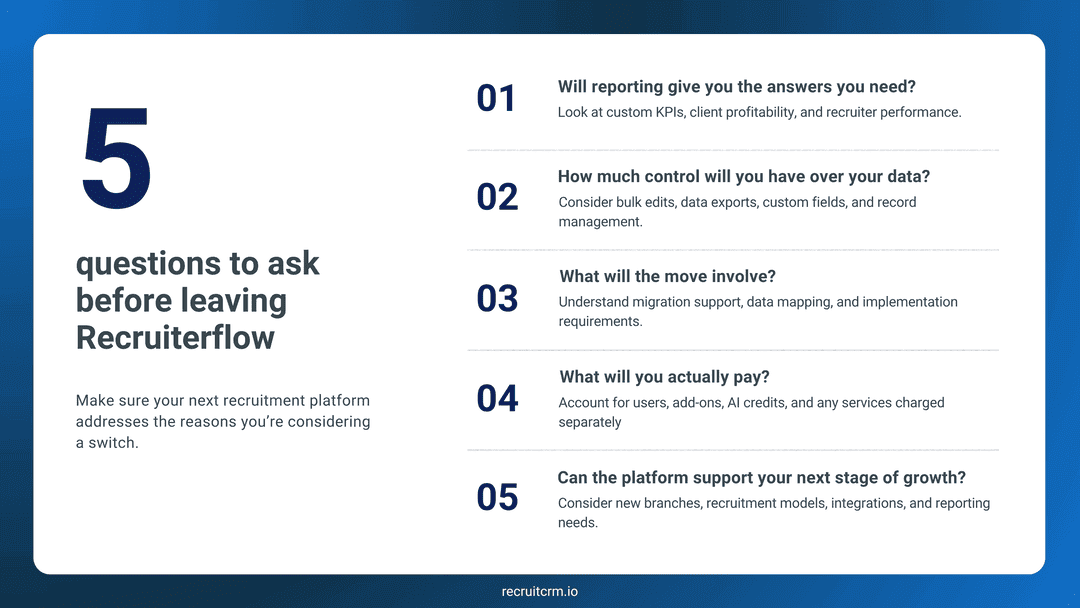
Your recruiters are making calls, submitting candidates, and closing placements. But when it's time to see what's actually driving results, can your CRM give you the answers you need?
Having all your recruitment data in one place is great. But if getting the right numbers requires multiple steps, like adjusting filters, exporting reports, or finding workarounds, it can get frustrating.
That's one concern worth considering with Recruiterflow.
While Recruiterflow CRM offers recruitment automation, AI-powered features, and reporting tools, getting custom reports exactly the way your agency needs them hasn't always been straightforward.
And when you're making decisions about recruiter performance, client accounts, and revenue, you need reports that tell you more than just how busy your team is.
So we've rounded up 6 Recruiterflow alternatives, including Recruit CRM, Bullhorn, and Thrive TRM, that offer different approaches to recruitment analytics, candidate management, and agency operations.
Let's see what each one brings to the table!
 1. Recruit CRM
Your recruitment software should do more than track candidates and automate emails. It should help your team deliver better submissions, impress clients, and understand what's driving revenue.
That's where Recruit CRM stands out as a Recruiterflow alternative.
Built specifically for recruitment and staffing agencies, Recruit CRM is an AI-first ATS + CRM that brings together candidate sourcing, client management, AI agents, and business reporting.
Here's what makes Recruit CRM worth considering:
- Send polished resumes to clients: Use the Resume Formatting Agent to turn candidate CVs into professional, branded documents with consistent formatting and sensitive details removed.
- Create stronger candidate submissions: The Candidate Submission Agent uses candidate profiles and job requirements to prepare client-ready submissions, helping recruiters present relevant candidates faster.
- Get a clearer picture of agency performance: Use Advanced Analytics to build custom reports and dashboards that track revenue, placements, recruiter activity, and client performance.
- Manage contractor timesheets and billing: Use Bill & Pay to collect contractor timesheets, manage client approvals, apply billing rules, and generate invoices without relying on separate systems.
Want to see how Recruit CRM fits your agency's recruitment process? Book a demo(opens in a new tab) and take a closer look at its capabilities.
2. Bullhorn(opens in a new tab)
How do you know which recruiters are performing well, which job orders need attention, and where your agency could be missing opportunities?Bullhorn helps staffing firms answer these questions through its recruitment platform and reporting capabilities. Alongside its ATS + CRM, it offers tools to monitor team performance, analyze recruitment activity, and connect data across the business.
Key features:
- Recruiter performance dashboards: Track individual and team activity, including calls, submissions, placements, and progress against targets.
- Bullhorn Analytics: Build configurable reports to examine recruitment trends, pipeline performance, and revenue opportunities.
- Bullhorn Data Hub: Bring together data from Bullhorn products, marketplace integrations, and supported external systems for more comprehensive reporting.
3. Thrive TRM(opens in a new tab)
Executive search firms need a clear way to assess senior candidates, collect client feedback, and keep track of decisions throughout lengthy search assignments.Thrive TRM helps executive search firms manage these activities through a platform designed for senior-level hiring. It brings together candidate assessments, search progress, and client collaboration.
Key features:
- Structured candidate assessments: Create standardized interview scorecards and evaluation criteria to compare executives consistently across a search.
- Client collaboration: Invite clients and other stakeholders to review candidates, share feedback, and contribute to hiring decisions, while maintaining control over access to sensitive information.
- Executive compensation benchmarks: Access anonymized compensation data to support discussions about leadership salaries and hiring expectations.
4. CATS(opens in a new tab)
CATS gives recruiters more control over how candidates move through the hiring process. Agencies can set their own recruitment stages, define what happens at each step, and decide which activities should happen automatically.The platform also offers practical tools for handling incoming resumes and keeping candidate conversations connected to their records.
Key features:
- Resume Inbox: Forward resumes to a dedicated email address, and CATS automatically parses them into candidate profiles. You can also route candidates to specific job pipelines.
- Workflow triggers: Set actions to run when candidates reach certain stages, such as scheduling interviews, sending emails, or submitting profiles to clients.
- Email history tracking: Automatically sync candidate and client email conversations to their respective records for easier follow-ups.
5. JobDiva(opens in a new tab)
A candidate may have the right experience on their resume, but that doesn't always mean they're the right fit for a role.JobDiva helps staffing agencies assess candidates and manage conversations before presenting them to clients. Its interviewing, assessment, and communication tools work alongside its ATS + CRM to support candidate evaluation.
Key features:
- Online skills assessments: Evaluate candidates using questionnaires and proficiency tests tailored to specific job requirements.
- Video interviewing: Conduct candidate interviews through JobDiva and retain recordings for future reference or client review.
- DivaBuzz texting: Send and receive SMS messages with candidates while keeping conversations connected to their recruitment records.
6. SmartSearch(opens in a new tab)
Getting a candidate shortlisted is one thing. Making sure they have completed all documents, screening requirements, and pre-employment checks before their start date is another.SmartSearch helps recruitment and staffing agencies manage these steps through its candidate onboarding and compliance tools. It gives recruiters a structured way to track requirements and prepare candidates for placements.
Key features:
- CandidateTraks: Collect candidate information, manage screening requirements, and organize documents during preboarding, even before a placement is confirmed.
- OnboardTraks: Create onboarding workflows with conditional steps, task dependencies, and automated reminders to keep pre-employment requirements on track.
- SmartSign: Let candidates review and electronically sign employment documents from their devices, without relying on a separate e-signature application.
What makes these 6 Recruiterflow alternatives worth switching to?
Recruiterflow offers AI agents, multichannel outreach, recruitment automation, and reporting. Here's how it compares with six alternatives on pricing, job posting, AI capabilities, contract staffing, and G2 ratings.| Platform | Starting price | Job multiposting | AI Sourcing/Matching | Contract staffing (timesheets, billing) | G2 rating |
| Recruiterflow | From $119/user/month | Job posting available | AIRA matching and AI agents | Limited dedicated back-office tools | 4.6/5 |
| Recruit CRM | From $95/user/month | 3,000+ job boards | AI sourcing, 800M+ profiles | Bill & Pay | 4.8/5 |
| Bullhorn | Plan-based pricing | Job posting available | Amplify AI and matching | Workforce solutions | 4.2/5 |
| Thrive TRM | Custom quote | Not a core focus | Executive talent research | Not a core focus | 5.0/5 (1 review) |
| CATS | From $69/user/month | Job posting available | Candidate search and matching | Limited back-office tools | 4.3/5 |
| JobDiva | Custom quote | Job board integrations | AI-assisted candidate search | Timesheets, billing | 4.7/5 |
| SmartSearch | Custom quote | Job posting available | AI Smart matching | Timekeeping; accounting integrations | 4.0/5 |
Frequently asked questions
1. What are the best Recruiterflow alternatives for recruitment agencies?
Recruit CRM is a strong Recruiterflow alternative for agencies looking for an AI-first ATS + CRM with sourcing, client management, AI agents, and advanced reporting.Its capabilities include AI-powered CV formatting, candidate submissions, custom analytics, and sourcing across 800M+ external profiles.
Other options include Bullhorn for staffing analytics, Thrive TRM for executive search, CATS for configurable workflows, JobDiva for candidate assessments, and SmartSearch for candidate onboarding and compliance management.
2. Recruit CRM vs Recruiterflow: How do they compare?
When comparing Recruit CRM vs Recruiterflow, both platforms offer applicant tracking, recruitment CRM, AI-powered features, and workflow automation.If you're evaluating Recruiterflow ATS against Recruit CRM, look at how each platform handles your agency's reporting requirements, candidate submissions, and daily recruitment workflows.
Recruit CRM offers dedicated agents for CV formatting and candidate submissions, along with Advanced Analytics for creating customized reports and dashboards.
The better choice depends on the workflows your recruiters use most and the level of customization they need.
3. Which Recruiterflow alternatives are suitable for executive search firms?
Recruit CRM is a great option for executive search firms that manage long-term candidate relationships and multiple client assignments.Its executive search software helps consultants organize confidential searches, maintain detailed candidate histories, and manage client communications. Recruiters can also build talent pools and track relationships with senior executives for future opportunities.
4. What should staffing agencies consider beyond ATS and CRM features?
Staffing agencies need software that supports the work involved in managing placements, contractors, and client relationships.Recruit CRM combines an AI-first ATS + CRM with contract staffing management through its Bill & Pay solution. Agencies can manage contractor timesheets, client approvals, billing rules, and invoicing in one place.
It also offers Advanced Analytics to track recruitment performance, revenue, and other business metrics, giving agencies greater visibility into their operations.
Blog summary
Recruiterflow offers AI-powered recruitment tools, but agencies may have different priorities for reporting, candidate management, and staffing operations.Here’s a quick recap of the 6 Recruiterflow alternatives covered in this blog:
- Recruit CRM: An AI-first ATS + CRM with specialized AI agents, customizable reporting, executive search capabilities, and 24/7 support.
- Bullhorn: Offers recruitment performance analytics, business intelligence, and data management tools for staffing firms.
- Thrive TRM: Supports retained executive search with structured candidate assessments, leadership research, and client collaboration.
- CATS: Helps recruiters manage resume intake, automate hiring stages, and customize recruitment workflows.
- JobDiva: Provides candidate skills assessments, video interviewing, and integrated texting for staffing agencies.
- SmartSearch: Helps staffing agencies manage candidate preboarding, document collection, electronic signatures, and compliance requirements through configurable workflows.
If you're considering a switch, Recruit CRM brings your recruitment activities and agency operations into one platform, backed by flexible workflows, guided migration, and round-the-clock customer support.
Book a demo(opens in a new tab) to see how Recruit CRM can support your team.



Blog written by
Vedika Luhariwala
Content strategist at Recruit CRM
Vedika is a content strategist at Recruit CRM, specializing in creating research-driven content for recruiters. She focuses on delivering practical, actionable insights that help recruitment professionals optimize their workflows, enhance candidate engagement, and scale their operations.